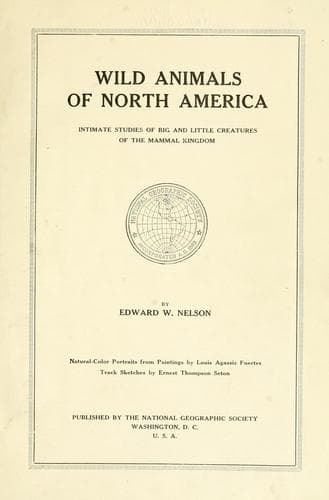
Wild Animals of North America: Intimate Studies of Big and Little Creatures of the Mammal KingdomNelson, Edward William
Science
Wild Animals of North America: Intimate Studies of Big and Little Creatures of the Mammal Kingdom
Nelson, Edward William
Mammals -- North America
The mink by preference is a forest animal, living along the wooded
bottom-lands of rivers or the thicket-grown borders of small streams,
where the rich vegetation gives abundance of shelter and at the same
time attracts a wealth of small mammals and birds on which it may prey.
From these secure coverts it wanders through the surrounding country at
night, visiting many chicken-houses on farms and leaving devastation
behind. It is persistent and bold in such forays and in locations near
its haunts great care must be exercised to guard against it. Minks have
repeatedly raided the enclosures of the National Zoological Park in
Washington.
Now and then, on the banks of some wild stream, one will try to
appropriate the catch lying at the very feet of a lone fisherman.
A naturalist fishing on a stream in northern Canada, seeing a mink
making free with his catch, set a small steel trap on the bare ground,
and holding the attached chain in one hand raised and slowly drew
toward him the fish upon which the mink was feeding. The mink, without
hesitation, followed the fish and was caught in the trap.
An abundance of food may modify the preference of the mink for wooded
or partly wooded country. The marshy and treeless tundra lying near
sea-level in the triangle between the coast of Bering Sea, and the
lower parts of the Yukon and Kuskokwim rivers offers such an attractive
situation differing from their usual haunts. The sluggish streams and
numberless ponds abound with small fish four to five inches long. Minks
swarm in this area to such an extent that the Eskimos who inhabit the
district are known among the natives of the surrounding region as the
“mink people.” Steel traps are used there, but a primitive method is
even more successful. A wicker fence is built across a narrow stream
and a small fyke fish-trap placed in it. In swimming along the stream
minks pass into the trap like fish, and I knew of from 10 to 15 being
thus taken in one day.
During my residence in that region from 10,000 to 15,000 mink skins
were caught in this tundra district annually, and the supply appeared
to be inexhaustible. With the growing occupation of the continent and
the increasing demand for furs, however, the numbers of the mink must
surely decrease. To forestall the shortage of furs that seems imminent,
efforts are now being made to establish fur farming to replace the
declining supply of wild furs with those grown under domestication. The
mink appears to be well adapted to successful breeding in captivity.
The main question to solve is the relation of the cost of caring for
the animals to the value of its pelt in the market.
=THE MARTEN, OR AMERICAN SABLE= (=Martes americana= and its
relatives)
(_For illustration, see page 555_)
Public-domain text, read in full here on John Shaqi.
Reviews
Reviews
No reviews yet
Be the first to share your thoughts on this work.
Elsewhere in the archive
Join the Discussion
Join the discussion
Sign in to leave a comment or review.
Sign InorCreate an account