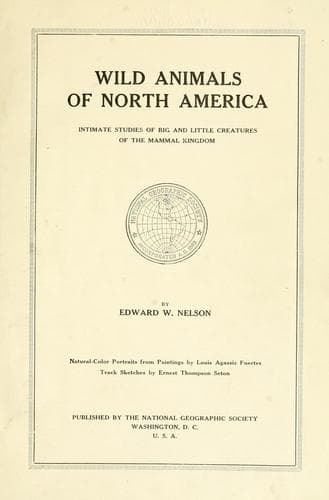
Wild Animals of North America: Intimate Studies of Big and Little Creatures of the Mammal KingdomNelson, Edward William
Science
Wild Animals of North America: Intimate Studies of Big and Little Creatures of the Mammal Kingdom
Nelson, Edward William
Mammals -- North America
Wild animals possess an endless variety of mental traits which endow
them in many instances with marked individualities. Few are more
strongly characterized in this respect than the marten. One of the
most graceful and beautiful of our forest animals, it frequents the
more inaccessible parts of the wilderness and retires shyly before the
inroads of the settler’s ax. Its rich brown coat, so highly prized
that the pursuit of it goes on winter after winter in all the remote
forests of the North, is a source of danger threatening the existence
of the species. The full-grown animal weighs five or six pounds and
measures nearly three feet in length.
The martens are circumpolar in distribution, and the several species
occupy northern lands from England, Europe, and northern Asia to North
America. Of the Old World species, the Siberian sable is best known on
account of the beauty of its fine, rich fur, which renders it the most
valued of all in the fur markets of the world.
The North American marten is a close relative of the Siberian species,
and occupies all the wooded parts of North America from the northern
limit of trees southward in the forested mountains to Pennsylvania, New
Mexico, and the southern part of the Sierra Nevada in California.
Like other members of the weasel tribe, the marten is a fierce and
merciless creature of rapine, but unlike the mink and weasel, it avoids
the abodes of man and loves the remotest depths of the wilderness.
Martens are endowed with an exceedingly nervous and excitable
temperament, combined with all the flashing quickness of weasels. They
are more restless than any other among the larger species of their
notably restless tribe, and couple with this extraordinary and tireless
vigor. This is admirably shown in captivity, when by the hour they
dart back and forth, up and down and around their cages with almost
incredible speed.
In the forest they climb trees and jump from branch to branch with
all the agility of a squirrel--in fact, they pursue and capture red
squirrels in fair chase, and have been seen in pursuit of the big
California gray squirrel (_Sciurus griseus_). On the ground they move
about quickly, hunting weasel-like, under brush piles and other cover.
Practically every living thing within their power falls victim to their
rapacity. They eat minks, weasels, squirrels, chipmunks, wood rats,
mice of many kinds, conies, snowshoe hares, ruffed and spruce grouse,
and smaller birds of all kinds and their eggs, as well as frogs, fish,
beetles, crickets, beechnuts, and a variety of small wild fruits.
Unlike minks and weasels, they are not known to kill wantonly more than
they need for food.
They make nests of grass, moss, and leaves in hollow trees, under logs,
among rocks, and in holes in the ground. Sometimes they have been found
in possession of a red squirrel’s nest, probably after having slain and
devoured the owner.
Public-domain text, read in full here on John Shaqi.
Reviews
Reviews
No reviews yet
Be the first to share your thoughts on this work.
Elsewhere in the archive
Join the Discussion
Join the discussion
Sign in to leave a comment or review.
Sign InorCreate an account