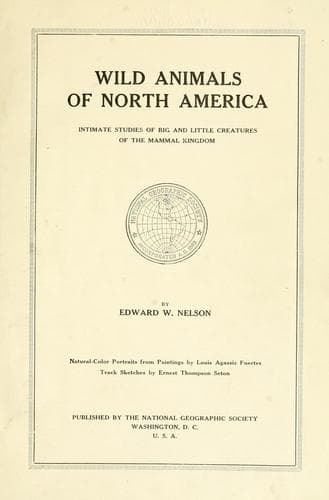
Wild Animals of North America: Intimate Studies of Big and Little Creatures of the Mammal KingdomNelson, Edward William
Science
Wild Animals of North America: Intimate Studies of Big and Little Creatures of the Mammal Kingdom
Nelson, Edward William
Mammals -- North America
The young, varying from one to eight in number, are born in April
or May. At first they are naked and helpless, but when large enough
accompany the mother on her search for food. This period of schooling
lasts until they are forced to take up their separate lives with the
approach of winter. Thenceforth they are among the most solitary of
animals, showing fierce antagonism toward one another whenever they
meet, and associating only during a brief period in the mating season
in February or March. Martens show a cold-blooded ferocity toward one
another that often renders it dangerous to put two or more in the same
cage. When placed in a cage together the male very commonly kills the
female by biting her through the skull. At times they utter a loud,
shrill squall or shriek, and in traps hiss, growl, and sometimes bark.
Among the dense forests of spruce and lodge-pole pine high up in
the mountains of Colorado, martens are sometimes hunted on skis in
midwinter, an exciting and often, on these rugged slopes, a dangerous
sport. They are not wary about traps and are readily caught by
deadfalls and other rude contrivances as well as by steel traps. In
Colorado and Montana hundreds of their skins are taken by trappers
every winter.
In Siberia the sable has been exterminated by hunting in many
districts, and before the present war began had become so scarce in
others that the Russian Government closed the season for them for a
period of years over nearly all of their range. The same reduction in
the numbers of our marten has occurred in most parts of Alaska and
elsewhere in its range, and its only hope against extermination lies in
stringent protection. Protective regulations are already in force in
Alaska.
During the early fur-trading days in northern Canada the number
of martens varied between comparative abundance and rarity. These
variations were said to occur about every ten years. Some claimed the
decrease was due to a migration which the martens were believed to make
from one region to another, just as was believed of the lynx. The lack
of a corresponding increase in surrounding districts, where trading
posts were located, effectually disproved the migration theory. There
is little doubt that the increase of martens was due to a reproductive
response to a plentiful food supply during years when mice or snowshoe
hares were abundant and their decrease was due to a lessening of the
numbers of these food animals.
Efforts are being made to domesticate martens and raise them for their
skins on fur farms. The main difficulty so far encountered lies in
the fiendish manner in which the old males kill the females and the
younger males. Although always nervous, they are not difficult to tame,
and will be most entertaining and attractive animals to rear if their
savage natures can be sufficiently overcome.
=THE LITTLE SPOTTED SKUNK= (=Spilogale putorius= and its
relatives)
(_For illustration, see page 558_)
Public-domain text, read in full here on John Shaqi.
Reviews
Reviews
No reviews yet
Be the first to share your thoughts on this work.
Elsewhere in the archive
Join the Discussion
Join the discussion
Sign in to leave a comment or review.
Sign InorCreate an account