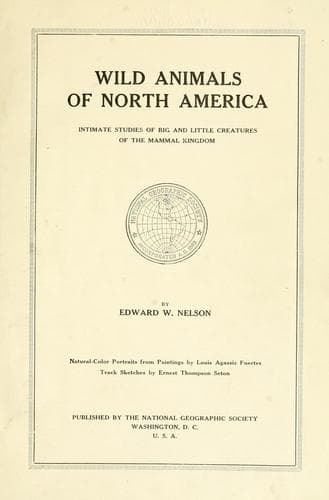
Wild Animals of North America: Intimate Studies of Big and Little Creatures of the Mammal KingdomNelson, Edward William
Science
Wild Animals of North America: Intimate Studies of Big and Little Creatures of the Mammal Kingdom
Nelson, Edward William
Mammals -- North America
Although both the little spotted and common skunks live mainly on
insects, the hog-nosed skunks are even more insectivorous in their
feeding habits. The bare snout appears to be used constantly for the
purpose of rooting out beetles, grubs, and larvæ of various kinds from
the ground.
On the highlands of Mexico I have many times camped in localities where
patches of ground were rooted up nightly by these skunks to a depth
of two or three inches as thoroughly as might have been done by small
pigs. In such places I repeatedly failed to capture them by traps
baited with meat, the insects and grubs they were finding apparently
being more attractive food. I have had similar failures in trapping for
coyotes with meat bait in localities where they were feeding fat on
swarms of large beetles and crickets. The persistence with which the
hog-nosed skunks hunt insects renders them a valuable aid to farmers.
In addition to grasshoppers, crickets, beetles, flies, grubs, and other
larvæ, and many other insects, they are known to eat wood rats, mice,
and the small fruit of cactuses and other plants. The stomach of one of
these skunks examined in Texas contained about 400 beetles.
One Texas naturalist writes that he has lost a number of young kids
which had their noses bitten off, and in one instance caught one of
these skunks mutilating a kid in this manner. He also states that they
pull down and eat corn when it is in the “roasting-ear” stage.
Far less is known concerning the habits of hog-nosed skunks than of
the other species of these animals. The number of young appears to be
small, judging from the record of a single embryo found in one animal
and in another instance of two young found in a nest located in a
hollow stump. They have a curiously stupid, sluggish manner and have
even less vivacity than the somewhat sedate common skunk. No use is
made of their skins in this country or in Mexico, but the gigantic
natives of Patagonia make robes of them which are worn like great
cloaks.
=THE NINE-BANDED ARMADILLO= (=Dasypus novemcincta= and its
relatives)
(_For illustration, see page 559_)
Armadillos are distinguished from other mammals by having the nearly,
or quite, hairless skin developed into a bony armor covering the
upperparts of the head and body and all of the tail. They lack teeth in
the front of both upper and lower jaws, and are members of the group of
toothless animals which includes the ant-eaters. The insects they feed
on are licked up by the sticky surface of their extensile tongues.
In the remote past many species of armadillos, some of gigantic size,
roamed the plains of South America, and a number of small species
still exist there. These animals are peculiar to America and have their
center of abundance in the southern continent.
Public-domain text, read in full here on John Shaqi.
Reviews
Reviews
No reviews yet
Be the first to share your thoughts on this work.
Elsewhere in the archive
Join the Discussion
Join the discussion
Sign in to leave a comment or review.
Sign InorCreate an account