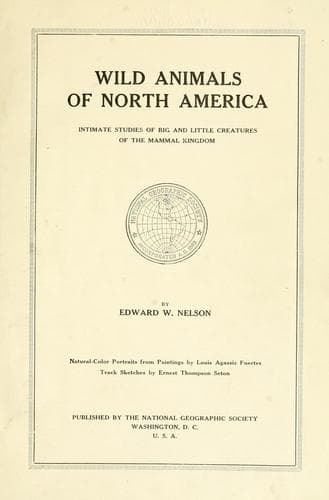
Wild Animals of North America: Intimate Studies of Big and Little Creatures of the Mammal KingdomNelson, Edward William
Science
Wild Animals of North America: Intimate Studies of Big and Little Creatures of the Mammal Kingdom
Nelson, Edward William
Mammals -- North America
The nine-banded species ranges over an enormous territory and is
subdivided into a number of geographic races, living from southern
Texas through Mexico and Central America to Argentina. In Mexico its
vertical distribution extends from sea-level up to an altitude of about
10,000 feet on the mountains of the interior. Like the hog-nosed skunk,
it no doubt originated as a member of the South American fauna and has
spread northward to its present limits. It is one of the larger of the
living representatives of this curious group of animals and reaches a
weight of from twelve to fifteen pounds.
As might be surmised from its appearance, the armadillo is a stupid
animal, living a monotonous life of restricted activities. Its sight
and hearing are poor, and the armored skin gives it a stiff-legged
gait and immobile body. From these characteristics, combined with the
small head hung low on a short neck, it has in life an odd resemblance
in both form and motion to a small pig; it jogs along in its trails or
from one feeding place to another with the same little stiff trotting
gait and self-centered air. If alarmed it will break into a clumsy
gallop, but moves so slowly that it may be overtaken by a man on foot.
So poor is its eyesight that a person may approach openly within about
thirty yards before being noticed.
When alarmed the armadillo immediately runs to the shelter of its
burrow, but may easily be caught in one’s hands, especially if
intercepted on the way to its den. When caught it will struggle to
escape, and while it may coil up in a ball in the presence of a dog
or other mammal foe, I never saw one try to protect itself in this
way. While presumably serving for protective purposes, the armor is
flexible on the sides of the body, and I have found the remains of many
armadillos where they had been killed and eaten by coyotes or other
predatory beasts. The armor would no doubt be sufficient protection to
enable them to escape to cover from the attack of birds of prey. They
are mainly nocturnal animals, but are frequently seen abroad by day and
in some places appear to be out equally by day or night.
This armadillo lives by preference amid the cover afforded by forests,
brushy jungle, tall grass, or other vegetation. In the midst of such
shelter it usually digs its own burrow a few yards deep in a bank or
hill slope, beneath a stump, under the roots of a tree, or a rock, or
even on level ground. It will also occupy small caves in limestone
rock. At times it shows a piglike fondness for a mud bath, and the
prints of its armor may be found where it has wallowed in miry spots.
Public-domain text, read in full here on John Shaqi.
Reviews
Reviews
No reviews yet
Be the first to share your thoughts on this work.
Elsewhere in the archive
Join the Discussion
Join the discussion
Sign in to leave a comment or review.
Sign InorCreate an account