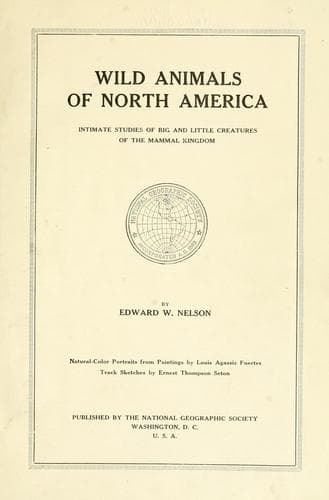
Wild Animals of North America: Intimate Studies of Big and Little Creatures of the Mammal KingdomNelson, Edward William
Science
Wild Animals of North America: Intimate Studies of Big and Little Creatures of the Mammal Kingdom
Nelson, Edward William
Mammals -- North America
Well-beaten and conspicuous trails lead from the burrows often for half
a mile or more, frequently branching through the thickets in various
directions. Armadillo burrows sometimes accommodate strange neighbors,
as was shown by one in Texas which was dug out, and in addition to
containing the owner in his den at the end, was found to be occupied by
a four-foot rattlesnake and a half-grown cottontail rabbit, each in a
side chamber of its own.
The food of the armadillo consists almost entirely of many species
of insects, among which ants appear to predominate. When searching
for food the animals become so intent that they may be cautiously
approached and closely observed or captured by hand. They root about
among fallen leaves and other loose vegetation and soft earth, now
and then digging up some hidden grub or beetle. At night they visit
newly plowed fields in their haunts, rooting in the mellow earth. They
are accused of digging up plants in gardens during their nocturnal
wanderings, and in Texas have been charged with robbing hens’ nests of
eggs, and of reducing the supply of wild turkeys and quail by breaking
up the nests, all of which needs confirmation. Their method of feeding
appears to vary considerably, as they have been seen rising on their
hind legs to secure small caterpillars infesting large weeds.
The insect food eaten by the nine-banded armadillo in Texas, as
known from examination of stomach contents, covers a wide range of
insect and other small life, including many species of grasshoppers,
crickets, roaches, caterpillars, beetles, ants, spiders, centipedes,
and earthworms. As the list includes also wireworms and other noxious
species, these inoffensive animals deserve thorough protection as a
most useful aid to the farmer.
Some time from February to April each year, litters of from four to
eight young are born. They have their eyes open at birth, and the armor
is soft and flexible like fine leather. The hardening of the skin into
a bony armor is progressive, continuing until after the animal fully
completes its growth. As soon as the young are able to travel they trot
along with the old one during her foraging trips.
Early one afternoon, when riding along a trail in the heavy forest of
southern Oaxaca, accompanied by an Indian boy and a pack of dogs, I
suddenly came upon an old armadillo and eight young about two-thirds
grown. They had heard our approach and stood motionless in a compact
little group half hidden in the grass. I had barely time to stop my
horse when the dogs spied them and made a rush. The armadillos darted
into the undergrowth in every direction like a litter of pigs, and with
the exception of two caught by the dogs gained safe refuge in their
burrow. This we found dug in the level ground about fifty yards from
where we encountered them.
Public-domain text, read in full here on John Shaqi.
Reviews
Reviews
No reviews yet
Be the first to share your thoughts on this work.
Elsewhere in the archive
Join the Discussion
Join the discussion
Sign in to leave a comment or review.
Sign InorCreate an account