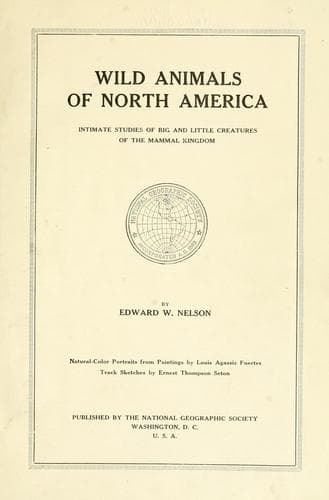
Wild Animals of North America: Intimate Studies of Big and Little Creatures of the Mammal KingdomNelson, Edward William
Science
Wild Animals of North America: Intimate Studies of Big and Little Creatures of the Mammal Kingdom
Nelson, Edward William
Mammals -- North America
The Maya Indians of the Peninsula of Yucatan have a legend that the
black-headed vulture (_Catharista atrata_) in old age changes into an
armadillo. The tale runs, that when a vulture becomes very, very old
it notifies its companions that the time has come and alights before a
hole in the ground that resembles the den of an armadillo. The other
vultures bring food and the old one remains there for a long time.
Its wings disappear, the feathers are lost, and when the change is
complete the newly created armadillo enters the hole and begins its new
life. If skepticism is expressed as to this metamorphosis, the Indians
point out as proof of the legend the similarity between the appearance
of the bald pate of the vulture and that of the armadillo.
[Illustration: AMERICAN MINK TRACKS, SHOWING VARIOUS ARRANGEMENTS AND
TAIL MARKS
The typical track of a mink is as in the bottom set at the left, which
also illustrates the tail mark. Twelve to twenty-four inches are
usually cleared at each bound. This illustration is greatly reduced
from natural size (see opposite page and pages 555 and 575).]
=THE RING-TAILED CAT= (=Bassariscus astutus= and its
relatives)
(_For illustration, see page 562_)
The mild climate and the proximity of the Southwestern States to Mexico
and the tropics brings within our borders numerous strange types of
wild life. Of these the ring-tailed cat is one of the most strikingly
marked and interesting. In the United States it is known by several
other names, including “civet cat,” “coon cat,” and “band-tailed cat.”
In Mexico it still bears the old Aztec name cacomixtle, except in Lower
California, where it is the “babisuri.” It is about the size of a large
cat but with proportionately longer and slenderer body, shorter legs,
and longer tail. The alternating bands of black and white on the tail
proclaim its relationship, not to the cat, to which it has no kinship,
but to the raccoon, which has a tail similarly marked. Few mammals
possess such a beautifully formed head and face, and its large, mild
eyes give it a vivid expression of intelligence.
The ring-tailed cat occupies areas under such differing climates as
to produce geographic races, but none of them vary strikingly from
the typical animal here illustrated. They range from Oregon, Nevada,
southern Utah, Colorado, and Texas south to Costa Rica. In Mexico they
occur from near sealevel up to an altitude of about 10,000 feet. While
chiefly rock-inhabiting species, they sometimes live in the forests and
as a rule make their dens in caves and deep crevices, but sometimes
in hollow trees or about houses. Their young, from three to four in
number, are born in May or June.
Public-domain text, read in full here on John Shaqi.
Reviews
Reviews
No reviews yet
Be the first to share your thoughts on this work.
Elsewhere in the archive
Join the Discussion
Join the discussion
Sign in to leave a comment or review.
Sign InorCreate an account