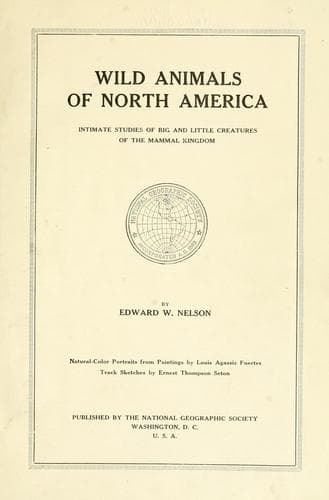
Wild Animals of North America: Intimate Studies of Big and Little Creatures of the Mammal KingdomNelson, Edward William
Science
Wild Animals of North America: Intimate Studies of Big and Little Creatures of the Mammal Kingdom
Nelson, Edward William
Mammals -- North America
The mountain lion, while powerful enough to be dangerous to man, is in
reality extremely timid. Owing to its being a potentially dangerous
animal, the popular conception of it is that of a fearsome beast, whose
savage exploits are celebrated in the folk-lore of our frontier. As a
matter of fact, few wild animals are less dangerous, although there are
authentic accounts of wanton attacks upon people, just as there are
authentic instances of buck deer and moose becoming aggressive. It has
a wild, screaming cry which is thrillingly impressive when the shades
of evening are throwing a mysterious gloom over the forests. In the
mountains of Arizona one summer a mountain lion repeatedly passed along
a series of ledges high above my cabin at dusk, uttering this loud
weird cry, popularly supposed to resemble the scream of a terrified
woman.
The mountain lion is usually nocturnal, but in regions where it is
not hunted it not infrequently goes abroad by day. It is a tireless
wanderer, often traveling many miles in a single night, sometimes in
search of game and again in search of new hunting grounds. I have
repeatedly followed its tracks for long distances along trails, and in
northern Chihuahua I once tracked one for a couple of miles from a bare
rocky hill straight across the open, grassy plain toward a treeless
desert mountain, for which it was heading, some eight or ten miles away.
Although inoffensive as to people, this cat is such a fierce and
relentless enemy of large game and live stock that it is everywhere an
outlaw. Large bounties on its head have resulted in its extermination
in most parts of the eastern United States and have diminished its
numbers elsewhere. It is not only hunted with gun and dog but also with
trap and poison.
A mountain lion usually secures its prey by a silent, cautious stalk,
taking advantage of every cover until within striking distance, and
then, with one or more powerful leaps, dashing the victim to the ground
with all the stunning impact of its weight. In a beautiful live-oak
forest on the mountains of San Luis Potosi I once trailed one of these
great cats to the spot where it had killed a deer a short time before,
and could plainly read in the trail the story of the admirable skill
with which it had moved from cover to cover until it reached a knoll
at one side of the little glade where the deer was feeding. Then a
great leap carried it to the deer’s back and struck the victim to the
ground with such violence that it slid 10 or 12 feet across the sloping
ground, apparently having been killed on the instant.
Another trail followed in the snow on the high mountains of New Mexico
led to the top of a projecting ledge from which the lion had leaped out
and down over 20 feet, landing on the back of a deer and sliding with
it 50 feet or more down the snowy slope.
Public-domain text, read in full here on John Shaqi.
Reviews
Reviews
No reviews yet
Be the first to share your thoughts on this work.
Join the Discussion
Join the discussion
Sign in to leave a comment or review.
Sign InorCreate an account