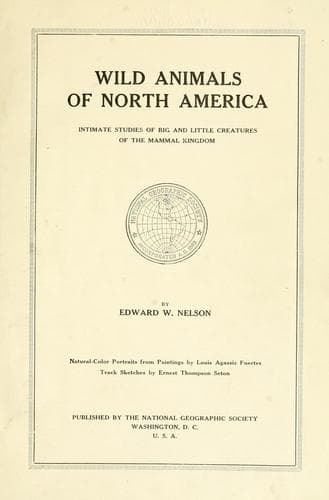
Wild Animals of North America: Intimate Studies of Big and Little Creatures of the Mammal KingdomNelson, Edward William
Science
Wild Animals of North America: Intimate Studies of Big and Little Creatures of the Mammal Kingdom
Nelson, Edward William
Mammals -- North America
Ordinarily the bobcat seems to be rather uncommon, but its nocturnal
habits usually prevent its real numbers being actually known. In
districts where not much hunted it is not uncommonly seen abroad by
day, especially in winter, when driven by hunger.
The bay lynx makes its den in hollows in trees, in small caves, and in
openings among rock piles wherever quiet and safety appear assured.
Although a shy animal, it persists in settled regions if sufficient
woodland or broken country remains to give it shelter. From such
retreats it sallies forth at night, and not only do the chicken roosts
of careless householders suffer, but toll is even taken among the lambs
of sheep herds.
As in the case of most small cats, the stealthy hunting habits of the
bay lynx renders it excessively destructive to ground-frequenting
birds, especially to quail, grouse, and other game birds. For this
reason, like many of its kind, it is outlawed in all settled parts of
the country.
=MOUNTAIN LION= (=Felis couguar= and its subspecies)
The mountain lion, next to the jaguar, is the largest of the cat tribe
native to America. In various parts of its range it is also known as
the panther, cougar, and puma. It is a slender-bodied animal with a
small head and a long round tail, with a total length varying from
seven to nine feet and a weight from about 150 to 200 pounds.
It has from two to five young, which are paler brown than the adult and
plainly marked with large dusky spots on the body and with dark bars
on the tail. These special markings of the young, as in other animals,
are ancestral, and here appear to indicate that in the remote past our
plain brown panther was a spotted cat somewhat like the leopard.
No other American mammal has a range equal to that of the mountain
lion. It originally inhabited both North and South America from
southern Quebec and Vancouver Island to Patagonia and from the Atlantic
to the Pacific coasts. Within this enormous territory it appears to be
equally at home in an extraordinary variety of conditions. Formerly
it was rather common in the Adirondacks of northern New York and
still lives in the high Rocky Mountains of the West, where it endures
the rigors of the severest winter temperatures. It is generally
distributed, where large game occurs, in the treeless ranges of the
most arid parts of the southwestern deserts, and is also well known in
the most humid tropical forests of Central and South America, whose
gloomy depths are drenched by almost continual rain.
A number of geographic races of the species have been developed by the
varied character of its haunts. These are usually characterized by
differences in size and by paler and grayer shades in the arid regions
and by darker and browner ones in the humid areas.
Public-domain text, read in full here on John Shaqi.
Reviews
Reviews
No reviews yet
Be the first to share your thoughts on this work.
Join the Discussion
Join the discussion
Sign in to leave a comment or review.
Sign InorCreate an account