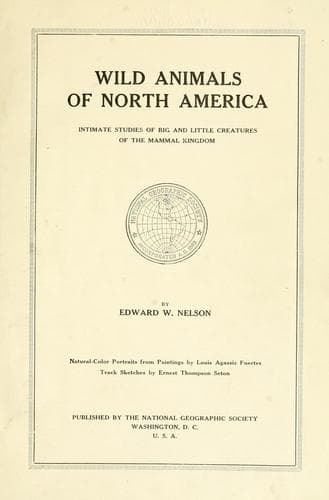
Wild Animals of North America: Intimate Studies of Big and Little Creatures of the Mammal KingdomNelson, Edward William
Science
Wild Animals of North America: Intimate Studies of Big and Little Creatures of the Mammal Kingdom
Nelson, Edward William
Mammals -- North America
No cessation of their activity occurs in winter. When the cold weather
begins many gather about barns and houses located near woods or old
fields, and thus with the field mice take advantage of the garnered
food supplies and shelter. Others remain in their regular haunts, where
they frequently burrow long distances in the snow, making networks of
tunnels and traveling long distances just below the surface, leaving
little raised ridges like the track of a mole on the ground. Their
journeys upon and under the surface of the snow appear to be in search
of food, as they burrow down to old logs and stumps which make good
feeding grounds. Their movements are very active, as they go about
either at a walk or quick trot.
These fierce and truculent little hunters are wholly beneficial in
their habits and should be encouraged in place of being killed on sight
indiscriminately, as one of the ordinary mouse tribe.
THE RED BAT (Nycteris borealis)
(_For illustration, see page 566_)
Bats reach their greatest development in the tropics, where a marvelous
variety of these curious mammals exist. To the northward the number
of species gradually decreases, until eventually, in northern Canada
and Alaska, a single species represents the group. The United States,
occupying the middle latitudes, has a considerable number of different
kinds. Some of these remain throughout the year, hibernating in caves
during the period of cold, when insects are not to be had; others wing
their way southward like birds on the approach of winter and return in
spring.
All bats are nocturnal, although individuals of some species
occasionally fly about for a time by day and many come out just before
or soon after sunset. In this country practically all species are
insectivorous, but in Mexico and the West Indies many are fruit-eaters
and a few true vampires or blood-suckers.
As a rule, bats are clothed in dull colors, but richly tinted coats
give a few a more attractive appearance. Of these none has a more
striking adornment than that presented by the soft covering of glossy
orange-red fur of the red bat. Its large size, about four inches in
total length, with a spread of wings amounting to twelve inches,
combined with its color, suffices to distinguish it at once from any
other northern species.
The range of the red bat extends from the Atlantic coast to the Pacific
and from Ontario and Alberta in southern Canada south throughout most
of the United States to the Gulf coast and southern California; also
beyond our limits to Lower California and Costa Rica. The genus to
which this bat belongs ranges more widely in other parts of North
America; also to South America and across the eastern Pacific to the
Galapagos and Hawaiian Islands.
Public-domain text, read in full here on John Shaqi.
Reviews
Reviews
No reviews yet
Be the first to share your thoughts on this work.
Elsewhere in the archive
Join the Discussion
Join the discussion
Sign in to leave a comment or review.
Sign InorCreate an account