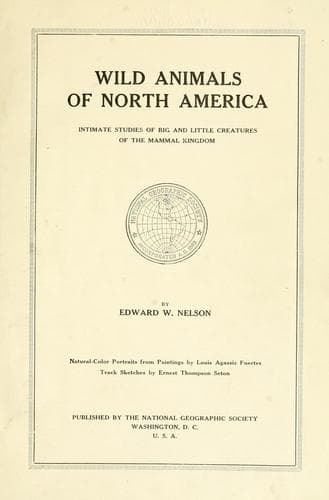
Wild Animals of North America: Intimate Studies of Big and Little Creatures of the Mammal KingdomNelson, Edward William
Science
Wild Animals of North America: Intimate Studies of Big and Little Creatures of the Mammal Kingdom
Nelson, Edward William
Mammals -- North America
The fisher is one of the largest and handsomest members of the weasel
family. Like others of this group, it is a long-bodied, short-legged
animal. It attains an extreme length of from 3 to 3½ feet and a weight
of 18 or 20 pounds, but the average is decidedly lower than these
figures. In general, it is like a gigantic marten, and from its size
and dark color is sometimes known locally as the “black cat” or “black
fox.”
It lives in the forested parts of Canada and the United States, where
it originally occurred from the southern shores of Hudson Bay and Great
Slave Lake south throughout most of eastern Canada and New England and
along the Alleghanies to Tennessee; also in the Great Lakes region,
south to the southern end of Lake Michigan; along the Rocky Mountains
to Wyoming, down the Cascades to northern California, and from the
Atlantic coast of Nova Scotia and Maine to the Pacific coast of
southeastern Alaska and British Columbia. They still occur regularly
in the Adirondacks of New York and the Green Mountains of Vermont and
in Maine, but are gone from most of the southern border of their former
range.
Fishers are powerful and agile animals, probably for their size by far
the swiftest and most deadly of all our forest carnivores. So swift
and dextrous are they in the tree-tops that they not only capture
squirrels without difficulty, but are able to overtake and kill the
marten, almost an incredible feat. When in pursuit of their prey or
when alarmed, they make astonishing leaps from tree to tree. While not
so speedy on the ground as some other animals, they have the tireless
persistence of their kind and capture snowshoe hares in fair chase.
Among the habitants of the forest the fisher is a fearless and savage
marauder, which feeds on frogs, fish, and nearly every bird and mammal
its domain affords, except species so large that their size protects
them. Porcupines are among its favorite victims and are killed by being
turned over and attacked on their underparts. As a consequence of such
captures, the fisher often has many quills imbedded in its head and the
foreparts of its body.
The fisher, like many other predatory animals, has more or less regular
“beats” along which they make their rounds over the territory each
occupies. These rounds commonly require several days to accomplish. In
winter they keep mainly along wooded ridges, where they are trapped.
It follows trap lines like the wolverine and eats the bait or the
captured animal, but, unlike the wolverine, appears to have no
propensity for further mischief. When overtaken by dogs or when at war
with any of its forest rivals, it is so active and ferocious that it is
worthy all due respect from antagonists several times its size.
Public-domain text, read in full here on John Shaqi.
Reviews
Reviews
No reviews yet
Be the first to share your thoughts on this work.
Elsewhere in the archive
Join the Discussion
Join the discussion
Sign in to leave a comment or review.
Sign InorCreate an account