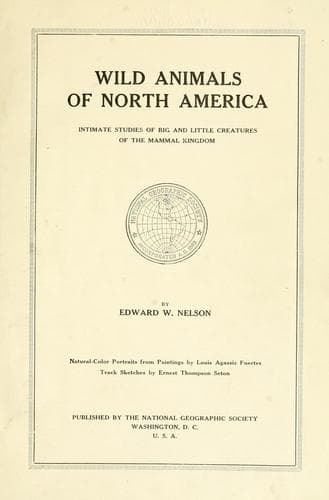
Wild Animals of North America: Intimate Studies of Big and Little Creatures of the Mammal KingdomNelson, Edward William
Science
Wild Animals of North America: Intimate Studies of Big and Little Creatures of the Mammal Kingdom
Nelson, Edward William
Mammals -- North America
Under primitive conditions, buffalo herds numbering millions of animals
regularly migrated in spring and fall from one feeding ground to
another, often traveling hundreds of miles for this purpose. The herds
followed the same routes year after year and made lasting trails, often
from two to three feet in depth. Investigation has shown that many of
our highways, and even some of our main railway lines, seeking the most
convenient grades, follow trails laid down by these early pathfinders.
When a great migrating herd was stampeded, the thunder of its countless
hoofs shook the earth, and in its flight it rushed like a huge black
torrent over the landscape.
The buffalo was the most important game animal to the Indians over a
great area. Several tribes were mainly dependent upon these animals for
food and clothing and the entire tribal economy was built about them.
The mode of life, customs, and folk-lore of the Indians all centered
about these animals. Their clothing and tepee covers were made of the
skins. The tanned skins also served as individual and tribal records of
the warrior-hunters, the chronicles being drawn in picture-writing on
the smooth surfaces. The passing of the buffalo on the free sweep of
the western plains ended forever one of the most picturesque phases of
aboriginal life in America.
=MUSK-OX= (=Ovibos moschatus= and its subspecies)
The musk-ox is one of the unique and most interesting of American
game animals. In general appearance it suggests a small, odd kind of
buffalo, and is, in fact, related to both cattle and sheep. It is a
heavily built, round-bodied animal, with short, strong legs and long
fringelike hair which hangs so low on the sides that it sometimes
trails on the snow. The horns--broad, flat, and massive at the
base--curve down and out to a sharp point on each side of the head and
form very effective weapons for defense.
Fossil remains prove that musk-oxen lived in northern Europe and Asia
during Pleistocene times, but they have long been confined to Arctic
America. Up to within a century they have occupied nearly all of the
cheerless wilds north of the limit of trees, from the coast of northern
Alaska to that of east Greenland. They appear to have become extinct in
northern Alaska within the last 75 years, and their present range east
of the Mackenzie River is becoming more and more restricted.
They are now limited to that part of the barren grounds of Canada lying
north and northwest of Hudson Bay and from the Arctic islands northward
and eastward to the northern coast of Greenland. Their range extends to
beyond 83 degrees of latitude and covers some of the bleakest and most
inhospitable lands of the globe. There a short summer, with weeks of
continuous sunshine, permits the growth of a dwarfed and scanty Arctic
vegetation; but winter brings a long period of night, continuous, in
the northernmost parts, through several months.
Public-domain text, read in full here on John Shaqi.
Reviews
Reviews
No reviews yet
Be the first to share your thoughts on this work.
Elsewhere in the archive
Join the Discussion
Join the discussion
Sign in to leave a comment or review.
Sign InorCreate an account