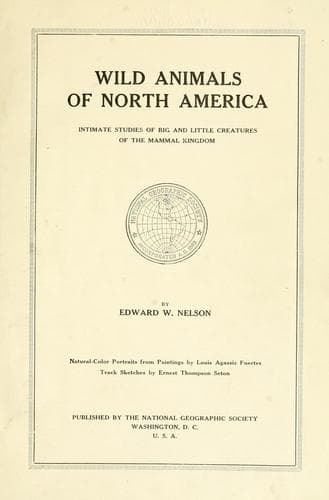
Wild Animals of North America: Intimate Studies of Big and Little Creatures of the Mammal KingdomNelson, Edward William
Science
Wild Animals of North America: Intimate Studies of Big and Little Creatures of the Mammal Kingdom
Nelson, Edward William
Mammals -- North America
Under such rigorous conditions musk-oxen thrive unless hunted by
civilized man. They are strongly gregarious, usually traveling in
herds of from six to twenty, but herds containing about 100 have been
recorded. Their eyesight is not strong, but their sense of smell is
good, and when danger is suspected they dash away with great celerity
for such heavily formed animals. If rocky ground is near, they seek
refuge in it and ascend steep, broken slopes with astonishing agility.
When brought to bay, the herd forms a circle about the calves and, with
heads out, presents to the enemy an unbroken front of sharp horns.
So long as the circle remains unbroken such a defense is extremely
effective against both dogs and wolves. The only natural enemies of
musk-oxen are wolves, and against these and the primitive weapons of
the Eskimos they hold their own very well.
When the Greely Expedition landed at Lady Franklin Bay in 1881,
musk-oxen were encountered and killed practically on the site where
winter quarters were established. Since then several exploring and
hunting parties have taken heavy toll from the herds of that region.
Some accounts of the wholesale killings do not make pleasant reading
for one who desires the perpetuation of our native species. Fortunately
for the musk-oxen, the adventurers of these northern quests are few and
far between, so that on departing they leave the game animals in their
vast solitudes to recuperate from these onslaughts.
Musk-oxen have but a single young, so that between depredations of
wolves and overkilling by white and native hunters these animals face
the very real danger of extermination threatening so many other game
animals in the far North. For this reason, it is hoped that sportsmen
who visit these remote game fields will restrain a desire for making
large bags.
FLORIDA MANATI (Trichechus latirostris)
The manatis, or manatees, are strange aquatic mammals, with seal-like
heads and whalelike bodies. Compared with whales, their flippers are
more flexible at the joints, and thus can be used much more freely.
They have very small eyes and a heavy upper lip, deeply cleft in the
middle and forming a thick lobe on each side. The skin is hairless and
covered with fine wrinkles.
These animals inhabit the rivers entering the sea and shallow coastal
lagoons on both sides of the Atlantic, in tropical parts of West Africa
and of eastern North and South America. The South American species
ascends the Amazon and its tributaries well up toward their headwaters.
The Florida manati regularly frequents the coast from eastern Florida
to Mexico, Central America, and the West Indies; in summer it sometimes
strays as far north as the coast of Virginia.
Public-domain text, read in full here on John Shaqi.
Reviews
Reviews
No reviews yet
Be the first to share your thoughts on this work.
Elsewhere in the archive
Join the Discussion
Join the discussion
Sign in to leave a comment or review.
Sign InorCreate an account