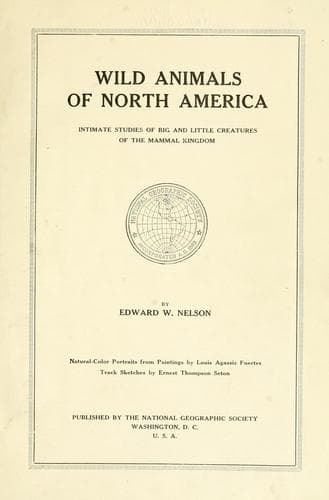
Wild Animals of North America: Intimate Studies of Big and Little Creatures of the Mammal KingdomNelson, Edward William
Science
Wild Animals of North America: Intimate Studies of Big and Little Creatures of the Mammal Kingdom
Nelson, Edward William
Mammals -- North America
This species attains an extreme length of more than 15 feet and a
weight of more than 1,500 pounds, but the average size is much less.
A large specimen exhibited alive at New Orleans the winter of 1912
weighed 1,310 pounds and is reported to have eaten daily from 60 to 100
pounds of grass. One captured near Point Isabel, Texas, measured a few
inches more than 15 feet in length.
Manatis were formerly plentiful in the Indian River and elsewhere
along the Florida coast, but were shot and netted to the verge of
extermination. They were killed not only for amusement by thoughtless
sportsmen, but many were killed by residents for their flesh, which
was salted down like beef for future use. The flesh is said to be well
flavored and not unlike beef.
The imminent danger of the extermination of these curious animals and
their evident value for the interest they lend the coastal waters of
the State led to the passage of protective laws with a penalty of $500.
As a result of this, manatis have increased rapidly. A correspondent,
writing on June 20, 1916, from Ponce Park, on Indian River, says that
at this season scarcely an hour in the day passes but that from one to
half a dozen may be seen in front of his house. He adds that one with
a “calf” about 3 feet long keeps about his dock all the time. In this
vicinity manatis appear to be migratory, leaving about the first of
December and returning in early spring, the first one noted in 1916
appearing on March 26. They are extremely susceptible to cold, as was
demonstrated by the number which perished in Indian River near Micco,
February 12, 1895, when the temperature fell to 20° Fahrenheit. They
are known to winter in Biscayne Bay and elsewhere in southern Florida.
Within a few weeks after the manatis return to the vicinity of Ponce
Park the young are born. Just before this the females are said to seek
the protection of a dock, crib, or bridge, possibly in order that the
new-born young may be safe from the sharks and sawfish which abound in
these waters. Usually there is only one calf, which is about 30 inches
long, but sometimes the mother is seen accompanied by two. During
this season the females are scattered and, with their young, keep in
comparatively shoal water near the shore, and not infrequently lie
in shallow pools with half their bodies exposed. Later in the season
they gather in herds and often 15 to 20 may be seen close together. At
such times they roll about and make a great turmoil in the water. The
Mexicans on the coast of southern Vera Cruz described to me similar
summer gatherings of manatis in small lagoons and claimed they were
there for the purpose of mating.
In fall, near Ponce Park, the larger animals, probably the old males,
separate from the herds and roam about singly. At this time they often
make a peculiar noise like a loud snort, which may be heard for half a
mile or more.
Public-domain text, read in full here on John Shaqi.
Reviews
Reviews
No reviews yet
Be the first to share your thoughts on this work.
Elsewhere in the archive
Join the Discussion
Join the discussion
Sign in to leave a comment or review.
Sign InorCreate an account