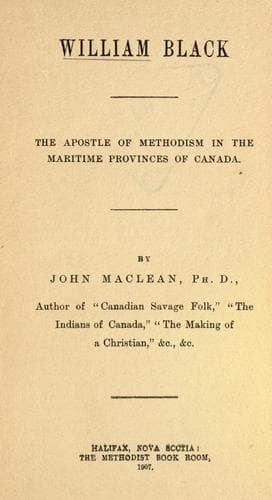
William Black: The Apostle of Methodism in the Maritime Provinces of Canada — John Shaqi
William Black: The Apostle of Methodism in the Maritime Provinces of CanadaMacLean, John
Religion
William Black: The Apostle of Methodism in the Maritime Provinces of Canada
MacLean, John
Black, William, 1760-1834; Wesleyan Methodist Church -- Clergy -- Biography
The kindness shown toward William Black during his visit to England,
and the fact that he was born there, naturally induced him to
entertain the idea of taking a circuit and spending his remaining
years in the old land, but Dr. Coke was strongly averse to him leaving
Nova Scotia where so great success had attended his labours, and his
influence was unbounded. Feeling that he could not very well leave the
care of the churches to others, without some provision being made for
superintending them in the event of his going to live in England, he
drew up a scheme of handing them over to the Methodist Episcopal
Church in the United States, and wrote to Bishop Asbury on the matter.
There were however political difficulties in the way, and being unable
to make satisfactory provision for supplying the churches with
ministers, and the danger of disaffection in the event of a war
between Great Britain and the United States, he decided to remain in
Nova Scotia and continue his active duties. Possessed of
administrative abilities of a high order, added to the skill and zeal
of an evangelist, he was a man of mark, who could not be left in
charge of a single circuit, but must have a wider field. Consequently
at the Conference held in Philadelphia in 1804, Dr. Coke requested him
to take a station in Bermuda for three or four years, and in order to
conciliate the members of the church in Halifax by the temporary
removal of their pastor, the Doctor wrote them a letter, in which he
said, "Mr. Black has been your apostle for above twenty years, and it
is now high time that he should be an apostle elsewhere. I have no
doubt that he will have a society of six hundred, or perhaps one
thousand members in Bermuda in four years. He may then, if he please,
return to superintend the work in Nova Scotia and New Brunswick, but
it will depend upon his own choice whether he return to you, or to
England, or remain at Bermuda." William Black consented to go, and
went to New York, where he engaged his passage, but was prevented from
reaching his destination by some persons from Bermuda who were opposed
to Methodism, and were going by the same vessel, and used their
influence so that the passage was cancelled. Two years later the
British Wesleyan Missionary Committee requested him to become
Superintendent of Missions in the West Indies, and Dr. Coke renewed
his request that he assume charge in Bermuda, but he declined the
appointment to the West Indies on the account of the severity of the
tropical climate, though he was willing to go to Bermuda. The Nova
Scotia District Meeting however intervened, and petitioned the British
Conference that he might be allowed to remain Superintendent of
Missions in the Maritime Provinces and Newfoundland, and there the
matter ended.
Public-domain text, read in full here on John Shaqi.
Reviews
Reviews
No reviews yet
Be the first to share your thoughts on this work.
Join the Discussion
Join the discussion
Sign in to leave a comment or review.
Sign InorCreate an account