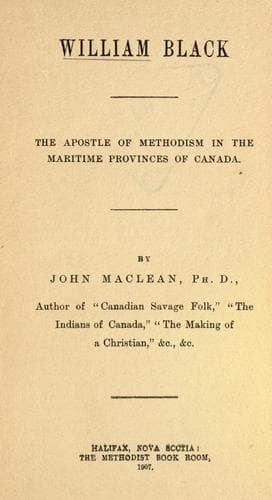
William Black: The Apostle of Methodism in the Maritime Provinces of CanadaMacLean, John
Religion
William Black: The Apostle of Methodism in the Maritime Provinces of Canada
MacLean, John
Black, William, 1760-1834; Wesleyan Methodist Church -- Clergy -- Biography
Meanwhile the arduous duties of visiting the churches and preaching
continued with much success, several new churches being built and
numerous conversions, among whom was Colonel Bayard who commanded one
of the British regiments at Halifax during the war, and afterwards
settled about 30 miles from Annapolis. He had been strongly opposed to
Methodism, but was led by William Black to a personal trust in Christ,
and lived such a holy life that he became known as the John Fletcher
of Nova Scotia. In the midst of a great revival which swept St. John,
and through the District from Barrington to Liverpool, there came
opposition from some preachers from Scotland, who spurned the idea of
conversion, however success followed the faithful preaching of William
Black and his fellow workers and many souls were led to Christ. In
1809 he was stationed in St. John, New Brunswick, where he spent two
years, but his active ministry was drawing to a close.
The privations and incessant labors began to tell upon a strong
constitution, so that in 1812 he was compelled to become a
supernumerary, though not desisting altogether from rendering whatever
service his health would permit in extending the cause that lay so
near his heart. Along with the Rev. William Bennett he was delegated
by the British Conference to attend the Conference in the United
States, and lay before the members the question of Canadian Methodism
retaining its allegiance with the British Conference, a task which was
faithfully performed, though of a very delicate character.
Increasing infirmities kept him in retirement, though he managed in
the spring of 1820 to pay a visit to the United States, where he
preached before Congress, and the passion for souls was still burning
in his soul, for the text of the sermon was, "What is a man profited,
if he gain the whole world and lose his own soul?" Brave and ever
resolute, he maintained his interest in the progress of the churches
which he founded, and it was with a pathos born of love to his
brethren, and the consciousness that his active work was done, that he
wrote to the ministers at the District Meeting held in St. John in
1823, that he was unable to attend, and sent them his blessing.
This man of daring had a definite religious experience and all his
preaching was with the individual in view, his sphere of labours was
not large in extent of territory, but he widened it by incessant
travel, without any show of rhetoric he won his way to men's hearts
and that is eloquence, and he lived to move Eastern British America by
translating his message in words imperishable, and lay foundations
upon which others have built. He was no common man, but an
empire-builder in the brave days of old.
VI.
PERSONAL CHARACTERISTICS.
Public-domain text, read in full here on John Shaqi.
Reviews
Reviews
No reviews yet
Be the first to share your thoughts on this work.
Join the Discussion
Join the discussion
Sign in to leave a comment or review.
Sign InorCreate an account