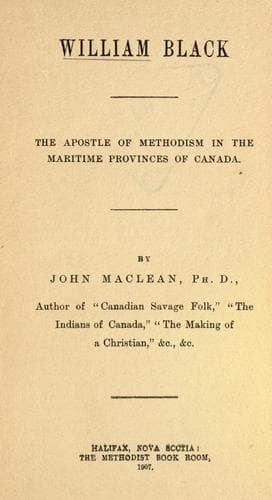
William Black: The Apostle of Methodism in the Maritime Provinces of Canada — John Shaqi
William Black: The Apostle of Methodism in the Maritime Provinces of CanadaMacLean, John
Religion
William Black: The Apostle of Methodism in the Maritime Provinces of Canada
MacLean, John
Black, William, 1760-1834; Wesleyan Methodist Church -- Clergy -- Biography
His closing years were spent in the quietness of his own home, with an
occasional service suited to his failing health. With a sublime
simplicity and faith in the goodness of women, he found a continual
benediction in his wife, who was a lady of good judgment, possessing a
cheerful spirit, and as earnest as he in her yearning after holiness
of heart and life, and a burning zeal for the salvation of souls. Born
in Boston, Massachusetts, where she frequently heard Whitefield
preach, she came with her parents to Fort Cumberland, Nova Scotia, and
settled there, when the British troops evacuated her native city, and
in the summer of 1781 she was converted under the ministry of William
Black. For the long period of forty-three years of married life, she
was the devoted companion and helper of her husband in every good
work. The training of five children devolved solely upon her, as she
was left alone during the long and frequent absence of her husband on
his missionary tours, yet she complained not, but counted it an honor
to share the joys and sorrows of a Methodist itinerant. With the true
instinct of a mother she governed her home in the fear of God. When
she chastised her children, she did not forget their spiritual
welfare, as it was her custom after punishment, to take them alone to
a private room, and there to pray with the culprit, and seldom were
these seasons unproductive of serious resolves of amendment. Her
letters to her husband bear the impress of a saint, in their spirit
of patience, sympathy with the erring, and quest after a better life.
During a period of severe sickness in the family, when three of the
children were laid low, and faint hopes were entertained for the
recovery of Celia, the eldest, the faith of the parents was severely
tried. While they were convalescing, the mother was attacked with a
raging fever, and in her weakened condition, she was strongly tempted
to doubt her acceptance with God. In her distress she mourned: "I have
lived too much at ease. How could I rest without daily and lively
communion with God." But the clouds burst, and she was enabled to
rejoice, and praise God for all his mercies to herself and family. She
was a saintly woman, active in her efforts for ameliorating the
condition of the poor in the city of Halifax, during her long
residence there. With her own hands she made garments for the needy,
stimulated others in connection with the Female Benevolent Society, of
which she was treasurer for several years, and by the sweetness and
beauty of her life, helped many in the paths of righteousness and
peace. During the last year and a half of her life she gradually
declined in health yet she murmured not, and when the end came on
August 11th, 1827, as she was surrounded by husband, children,
grandchildren and friends, she bade them an affectionate farewell. The
last to receive her blessing was her faithful and pious black servant,
but her power of speech having gone, she raised her hands to heaven as
Public-domain text, read in full here on John Shaqi.
Reviews
Reviews
No reviews yet
Be the first to share your thoughts on this work.
Join the Discussion
Join the discussion
Sign in to leave a comment or review.
Sign InorCreate an account