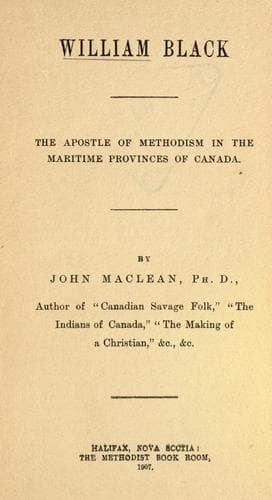
William Black: The Apostle of Methodism in the Maritime Provinces of CanadaMacLean, John
Religion
William Black: The Apostle of Methodism in the Maritime Provinces of Canada
MacLean, John
Black, William, 1760-1834; Wesleyan Methodist Church -- Clergy -- Biography
although I could never receive your peculiar opinions. But shall we on
this account destroy the work of God? God forbid! May the Lord take
away all bigotry, and fill us with pure, genuine, catholic love!" That
was charity indeed, but Henry Alline went on his way denouncing all
who did not follow him.
William Black had no fine capacity for anger, for with his soul aflame
with a holy passion he saw men and women as related to eternity, and
he loved them. With an iron will he laughed at danger, without any
austerity he was a great saint, his ideals were lofty, and
cheerfulness sat upon his lips and shone in his face, a practical
mystic was he without losing his head in the clouds, in brief, he was
a man, a brave soul with a woman's tenderness, who held his eyes
toward the Cross.
VII.
LAST DAYS AND AFTER.
The long years of arduous labor began to tell upon a strong
constitution, so that gradually the physical strength of the pioneer
evangelist and missionary in the Maritime Provinces became so
enfeebled, that during the last fifteen years of his life he was
practically laid aside. For forty years he travelled, unhasting,
unresting, swift of foot, and with an unquenching passion for souls,
and the hardships of those early times left their abiding impress upon
his body, though he still retained his natural vigor of mind. A
journey now and then in quest of health brought cheerful patience, but
his work was done, while still sixty years of age. Like another
Whitefield he had worn himself out in his Master's service, yet he was
content that foundations had been laid, and others might build, while
he shared their joy.
He lived in stirring times, and belonged to a sect that moved the
world, recreating the national conscience, without disturbing the
religious world with a new heresy. In 1807 the slave trade in the
British Empire was abolished, and the Methodist revival introduced a
new philanthropy, which brought a fresh impulse into the nation for
the reforming of the prisons, greater clemency to the penal laws, with
a noble and steady attempt to better the condition of the profligate
and the poor, and the first impetus toward popular education. Limited
in his range of vision by distance from the great centres of
civilization, and absorbed in his noble task of leading men in their
quest after godliness, he still kept in touch with the larger
questions which affected the nation, so far as the literature of that
day permitted.
Public-domain text, read in full here on John Shaqi.
Reviews
Reviews
No reviews yet
Be the first to share your thoughts on this work.
Join the Discussion
Join the discussion
Sign in to leave a comment or review.
Sign InorCreate an account