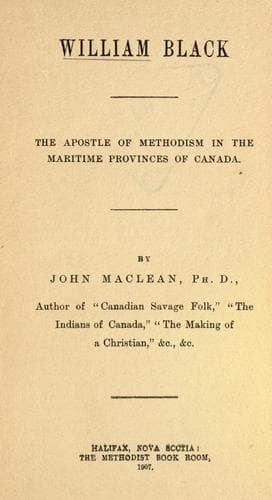
William Black: The Apostle of Methodism in the Maritime Provinces of CanadaMacLean, John
Religion
William Black: The Apostle of Methodism in the Maritime Provinces of Canada
MacLean, John
Black, William, 1760-1834; Wesleyan Methodist Church -- Clergy -- Biography
There were many others possessed of great gifts and culture, whose
hearts were set on fire with a passion for souls, and the revival
started spiritual forces which were felt far beyond the shores of
Great Britain.
Wesley was drawing near to seventy years of age, and while travelling
incessantly, and preaching every day, he was engaged in the
publication of a collected edition of his works, in thirty-two
duodecimo volumes. The Calvinistic controversy was at its height, the
first anniversary of Trevecca College, the pet scheme of the Countess
of Huntingdon, had just been held, and Fletcher was writing his famous
"Checks to Antinomianism," yet, the founder of the Methodist movement
was looking for other worlds to conquer, by the preaching of the
Cross.
Wesley's early associations with America as a missionary to Georgia,
naturally gave him an interest in the affairs of the western
continent, and Whitefield's frequent visits helped to deepen Wesley's
love for the people among whom he had spent the early years of his
ministry. Whitefield had crossed the ocean and visited America seven
times, and his visits were seasons of great power, when thousands were
converted, and when he suddenly died at Newburyport, there passed from
earth one of the greatest pulpit orators and evangelists in the
history of the Christian Church. His death was an invitation to
renewed efforts for the evangelization of America. The Countess of
Huntingdon and her ministers organized a missionary band, which
labored with much success in Savannah and the surrounding country,
especially among the African population.
Methodism was neither silent nor powerless in sharing in the progress
of the Gospel, and striving to evangelize the new world. While the
great revival was stirring the heart of England, a small band of
German "Palatines" which Methodism had redeemed from demoralization in
Ireland, emigrated to New York, among whom was Philip Embury, and
these were followed by Barbara Heck and her friends, through whose
efforts Methodism found a secure place in America. The new movement
received an impetus from the preaching of Captain Webb, and a call for
preachers was sent to Wesley, with the result that Richard Boardman
and Joseph Pilmoor were sent. Later Francis Asbury, the faithful
preacher and administrator, followed, and Methodism became a church.
Meanwhile Lawrence Coughlan had found his way to Newfoundland, and
laid foundations upon which others built.
Bermuda had been visited by Whitefield, and in the general awakening
it could not be expected that Nova Scotia and New Brunswick and Prince
Edward Island would be forgotten. It was a period of emigration and
revival, and in the great commotion, the present Maritime Provinces of
Canada shared in the blessings of the new movement.
Public-domain text, read in full here on John Shaqi.
Reviews
Reviews
No reviews yet
Be the first to share your thoughts on this work.
Join the Discussion
Join the discussion
Sign in to leave a comment or review.
Sign InorCreate an account