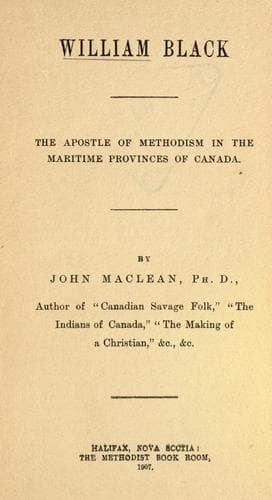
William Black: The Apostle of Methodism in the Maritime Provinces of CanadaMacLean, John
Religion
William Black: The Apostle of Methodism in the Maritime Provinces of Canada
MacLean, John
Black, William, 1760-1834; Wesleyan Methodist Church -- Clergy -- Biography
During the period of emigration to Nova Scotia, four different parties
came from Yorkshire, England, the first arriving in 1772. It was
natural to expect, that coming from a district, memorable as the scene
of many visits from the Wesleys, a bit of land consecrated with the
tears and labors of John Nelson, the stalwart hero, and kept fresh
with the hallowed memories of the saintly Hester Ann Rogers, there
should be among the emigrants many who were loyal and devoted
Methodists. Yorkshire Methodism was of that strenuous type which must
give expression to its faith in hearty song, and lively preaching, and
these sturdy settlers were an acquisition to the province, which the
politicians were sufficiently alert to see, could not fail to supply
the elements of stability and growth.
The majority of these people settled in the county of Cumberland, and
began life anew, with intense loyalty to the institutions, and high
ideals. The province had not fully recovered from the effect of the
spirit of disloyalty which culminated in the expulsion of the
Acadians, although there followed a period of peace, but despite the
efforts of the Government in making roads, and instituting public
works, the settlements were sparse, and the Indian was still in the
land. There was only one minister in the county, the Rev. John
Eagleson, who had been sent out in 1769 by the Society for the
Propagation of the Gospel, while in the province there were a few
Anglican, Congregational, Presbyterian and one Baptist church, but
places for holding religious worship were few and far between, and the
first Methodists consequently began prayer meetings in their homes,
and through them souls were led to Christ. Whatever religious services
were held they attended, and thus kept alive the glowing embers of
their faith and zeal.
An incipient rebellion, induced by the Revolutionary war, and
maintained by the sympathy of the colonists who had revolted in New
England, unsettled the minds of the people, and made it dangerous for
them to attend religious worship, and consequently the cause of
religion suffered, and many forsook the faith of their fathers. A few
still remained true, and amid many discouragements prayed for the dawn
of a new day.
Public-domain text, read in full here on John Shaqi.
Reviews
Reviews
No reviews yet
Be the first to share your thoughts on this work.
Join the Discussion
Join the discussion
Sign in to leave a comment or review.
Sign InorCreate an account