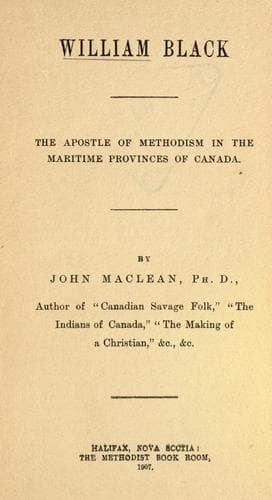
William Black: The Apostle of Methodism in the Maritime Provinces of CanadaMacLean, John
Religion
William Black: The Apostle of Methodism in the Maritime Provinces of Canada
MacLean, John
Black, William, 1760-1834; Wesleyan Methodist Church -- Clergy -- Biography
When William Black was only five years old John Wesley preached to a
large congregation in the Rev. Henry Venn's Church in the town. This
man of God was a zealous Methodist Churchman, who made Huddersfield
the headquarters of extensive labors in all the neighboring region,
sympathizing with the great Methodist revival, accompanying Whitefield
on evangelistic tours, and for more than thirty years, he co-operated
with the Wesleys and other workers in many parts of England and Wales.
Though still retaining his connection with the Church of England, he
continued in labors abundant, preaching in private houses, barns and
in the open air, until old age. His son, the Rev. John Venn, became
the projector of the Church Missionary Society. Methodism was firmly
established in Huddersfield, and its influences were not unknown to
the Black family. In 1767, one fourth of the members of the Methodist
Church in the United Kingdom were in Yorkshire, and among the first
settlers who came to Nova Scotia were some who were identified with
that church, and had listened to Wesley and his preachers.
William Black, the father of the future pioneer and evangelist, was
born in 1727, in Paisley, Scotland, a large manufacturing town noted
for its shawls, great preachers, and the birthplace of Tannahill, the
poet. He came of an independent family, as learned from the fact that
his father kept a pack of hounds, and spent his leisure in the chase.
When he attained his majority he became a traveller for a large
industry, which necessitated some journeys to England, and there he
met his future wife, and made his home in Huddersfield. The spell of
Scottish literature must have fallen upon the young man, for Robert
Burns, the poet, was then at the height of his fame, Alexander Wilson,
a native of Paisley, had not yet won his place as a poet, though he
too, emigrated to America, and became the pioneer and founder of
American Ornithology, but there were other writers whose impress must
have been felt by the Scotch youth.
In Elizabeth Stocks he found a lady of refinement and wealth, and the
future missionary a good Christian mother. She had been converted at
sixteen years of age, and her influence upon the home, and especially
upon the lad was elevating, and destined to leave its mark upon the
future. The father, with Scotch shrewdness, made a visit to Nova
Scotia to spy out the land before removing his family from their
English home. The mother watched tenderly over all the members of the
family, but William, the second oldest, seemed to call for special
care, and her tears and prayers found full fruition in after years,
when she had passed to her reward. Frequently did she relate to her
son William the story of her conversion, and with tears besought him
to serve God. Alone she prayed with him, and pressed home upon his
conscience the necessity of being born again. Surely this child was
born well, and his future was not all of his own making.
Public-domain text, read in full here on John Shaqi.
Reviews
Reviews
No reviews yet
Be the first to share your thoughts on this work.
Join the Discussion
Join the discussion
Sign in to leave a comment or review.
Sign InorCreate an account