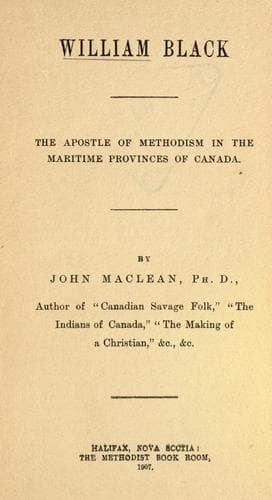
William Black: The Apostle of Methodism in the Maritime Provinces of Canada — John Shaqi
William Black: The Apostle of Methodism in the Maritime Provinces of CanadaMacLean, John
Religion
William Black: The Apostle of Methodism in the Maritime Provinces of Canada
MacLean, John
Black, William, 1760-1834; Wesleyan Methodist Church -- Clergy -- Biography
He must have been a precocious child, or else his religious
sensitiveness must have been induced by his mother's teaching,
influenced by the great doctrines of the Methodist revival. We are not
now accustomed to hear a child of six years of age, bewailing his lost
state in language suggestive of Bunyan's condition, when he was under
deep conviction of sin. He tells us that when he was five years old he
had some serious impressions, and God's Spirit began to operate upon
his mind, and when he was six, he often wished that he was a toad or a
serpent, because they had no soul, and were not in danger of being
lost forever. Again he says, that many times before he was ten years
old, he "would have overturned God's government and dethroned the
gracious Author of my being." He enumerates his early vices and lashes
his soul in despair. Such religious sentiments in one so young seem to
mark him as one who had in his soul the elements of a monk, and we
should not have been surprised had he become a zealous disciple of
Saint Francis of Assisi.
Like John Wesley, whose escape from perishing in the burning of the
Epworth parsonage is noted as a remarkable providence, William Black
had a narrow escape from drowning in a large trough when a child, and
this circumstance made a lasting and favorable impression on his mind.
In his mature years he recalled the event with gratitude to God.
Several years of his childhood were spent with his maternal uncle, Mr.
Thomas Stocks, at Otley, where he was placed at school. There he
remained until he was about thirteen years of age, when the
disciplinary rules of the school, and very likely a severe
castigation, so annoyed him, that he left his uncle's care and
returned to his father's home. His father was at that time making
preparations for his voyage to Nova Scotia, and deemed it prudent to
allow the lad to remain with his mother, though he had decided
objections to his apparent ingratitude and stubbornness, in leaving
the home of his uncle. Under the influence of his mother's teaching
and prayers, his religious impressions were deepened, but the jests of
his companions at school made him stifle his convictions, and continue
his career of youthful carelessness and sin.
Public-domain text, read in full here on John Shaqi.
Reviews
Reviews
No reviews yet
Be the first to share your thoughts on this work.
Join the Discussion
Join the discussion
Sign in to leave a comment or review.
Sign InorCreate an account