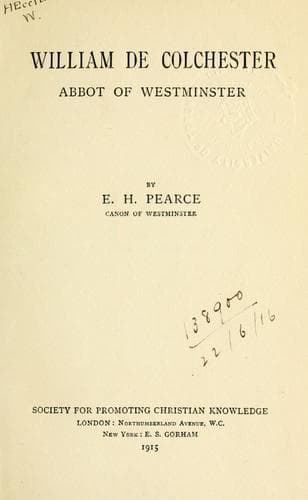
William de Colchester, Abbot of WestminsterPearce, Ernest Harold
History
William de Colchester, Abbot of Westminster
Pearce, Ernest Harold
William, of Colchester, Abbot of Westminster, approximately 1338-1420
In Shakespeare's _Tragedy of King Richard II._, there is an Abbot of
Westminster who flits craftily across the scene, generally shadowing a
Bishop of Carlisle, whom we shall meet again. When Bolingbroke announces
that he is about to be crowned King in Richard's stead, this Abbot bids
his friends--
"Come home with me to supper; and I'll lay
A plot shall show us all a merry day."[2]
In the next act[3] it is stated that he is dead--
"The grand conspirator, Abbot of Westminster,
With clog of conscience and sour melancholy
Hath yielded up his body to the grave."
As to which it must be sufficient to say that the poet who could not give
the Abbot's name was equally unconscious of the fact that he outlived
his alleged conspiracy by twenty years.
But his name was William Colchester, and we may begin by assuming that,
as his name implies, he was a Colchester man. In and before his time,
and for a considerable space afterwards, the customary designation of
a Brother was his Christian name and a place name, with or without the
copula _de_; in earlier years he called himself William de Colchester,
but the documents which concern him as Abbot mostly speak of William
Colchester, or William Abbot of Westminster. Nor are we left to
guess-work as to the place of his origin. In later life, according to
the habit of his time, he busied himself with the endowment of obits,
or anniversaries, for the good of his soul. Here is a document,[4]
dated May 20, 1406, in which he bargained with the Prior of St. Botolph,
Colchester, having paid 40_s._ to Henry IV.'s Clerk of the Hanaper to
seal the bargain, that one of the canon-chaplains of that Priory should
say Mass every week, at sixpence a week, for his soul and for the
souls of his parents; that the Prior and his Brethren should observe
his anniversary, again with a memorial of his parents, in the parish
church of St. Nicholas, Colchester; that a set sum should be distributed
yearly to the vicar of St. Nicholas, to the poor of the parish, and to
the prisoners in Colchester Castle; and that the tomb of his parents
in the parish churchyard should be kept in proper repair.
Public-domain text, read in full here on John Shaqi.
Reviews
Reviews
No reviews yet
Be the first to share your thoughts on this work.
Join the Discussion
Join the discussion
Sign in to leave a comment or review.
Sign InorCreate an account