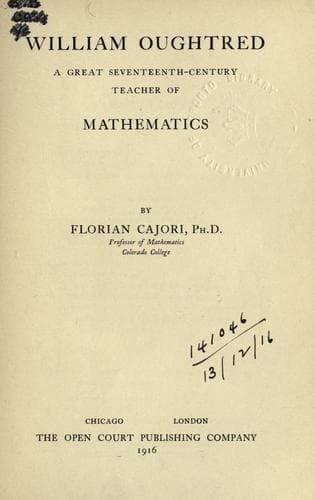
William Oughtred: A Great Seventeenth-Century Teacher of MathematicsCajori, Florian
History
William Oughtred: A Great Seventeenth-Century Teacher of Mathematics
Cajori, Florian
Mathematicians -- Biography; Mathematics -- Study and teaching -- History -- 17th century; Oughtred, William, 1575-1660
He sometimes amused himself with archery, and sometimes practised as a
surveyor of land. . . . . He was sprightly and active, when more than
eighty years of age.[16]
Another informant says that Oughtred was
as facetious in Greek and Latine as solid in Arithmetique, Astronomy,
and the sphere of all Measures, Musick, etc.; exact in his style as in
his judgment; handling his Cube, and other Instruments at eighty, as
steadily, as others did at thirty; owing this, he said, to temperance
and Archery; principling his people with plain and solid truths, as he
did the world with great and useful Arts; advancing new Inventions in
all things but Religion. Which in its old order and decency he
maintained secure in his privacy, prudence, meekness, simplicity,
resolution, patience, and contentment.[17]
ALLEGED TRAVEL ABROAD
According to certain sources of information, Oughtred traveled on the
European Continent and was invited to change his abode to the Continent.
We have seen no statement from Oughtred himself on this matter. He seldom
referred to himself in his books and letters. The autobiography contained
in his Apologeticall Epistle was written a quarter of a century before
his death. Aubrey gives the following:
In the time of the civill warres the duke of Florence invited him over,
and offered him 500 li. per annum; but he would not accept it, because
of his religion.[18]
A portrait of Oughtred, painted in 1646 by Hollar and inserted in the
English edition of the Clavis of 1647, contains underneath the following
lines:
“Haec est Oughtredi senio labantis imago
Itala quam cupiit, Terra Britanna tulit.”
In the sketch of Oughtred by Owen Manning it is confessed that “it is not
known to what this alludes; but possibly he might have been in Italy with
his patron, the Earl of Arundel.”[19] It would seem quite certain either
that Oughtred traveled in Europe or that he received some sort of an
offer to settle in Italy. In view of Aubrey’s explicit statement and of
Oughtred’s well-known habit of confining himself to his duties and
studies in his own parish, seldom going even as far as London, we
strongly incline to the opinion that he did not travel on the Continent,
but that he received an offer from some patron of the sciences—possibly
some distinguished visitor—to settle in Italy.
HIS DEATH
He died at Albury, June 30, 1660, aged about eighty-six years. Of his
last days and death, Aubrey speaks as follows:
Before he dyed he burned a world of papers, and sayd that the world was
not worthy of them; he was so superb. He burned also severall printed
bookes, and would not stirre, till they were consumed. . . . . I
myselfe have his Pitiscus, imbelished with his excellent marginall
notes, which I esteeme as a great rarity. I wish I could also have got
his Bilingsley’s Euclid, which John Collins sayes was full of his
annotations. . . . .
Public-domain text, read in full here on John Shaqi.
Reviews
Reviews
No reviews yet
Be the first to share your thoughts on this work.
Join the Discussion
Join the discussion
Sign in to leave a comment or review.
Sign InorCreate an account