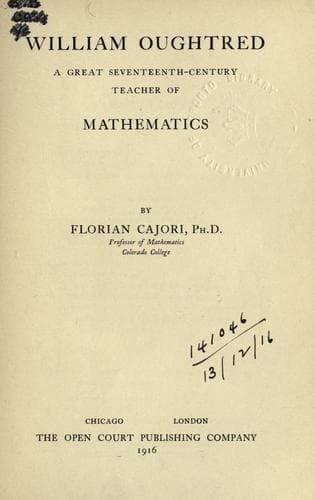
William Oughtred: A Great Seventeenth-Century Teacher of Mathematics — John Shaqi
William Oughtred: A Great Seventeenth-Century Teacher of MathematicsCajori, Florian
History
William Oughtred: A Great Seventeenth-Century Teacher of Mathematics
Cajori, Florian
Mathematicians -- Biography; Mathematics -- Study and teaching -- History -- 17th century; Oughtred, William, 1575-1660
As compared with other contemporary works on algebra, Oughtred’s
distinguishes itself for the amount of symbolism used, particularly in
the treatment of geometric problems. Extraordinary emphasis was placed
upon what he called in the Clavis the “analytical art.”[24] By that term
he did not mean our modern analysis or analytical geometry, but the art
“in which by taking the thing sought as knowne, we finde out that we
seeke.”[25] He meant to express by it condensed processes of rigid,
logical deduction expressed by appropriate symbols, as contrasted with
mere description or elucidation by passages fraught with verbosity. In
the preface to the first edition (1631) he says:
In this little book I make known . . . . the rules relating to
fundamentals, collected together, just like a bundle, and adapted to
the explanation of as many problems as possible.
As stated in this preface, one of his reasons for publishing the book, is
. . . . that like Ariadne I might offer a thread to mathematical study
by which the mysteries of this science might be revealed, and direction
given to the best authors of antiquity, Euclid, Archimedes, the great
geometrician Apollonius of Perga, and others, so as to be easily and
thoroughly understood, their theorems being added, not only because to
many they are the height and depth of mathematical science (I ignore
the would-be mathematicians who occupy themselves only with the
so-called practice, which is in reality mere juggler’s tricks with
instruments, the surface so to speak, pursued with a disregard of the
great art, a contemptible picture), but also to show with what keenness
they have penetrated, with what mass of equations, comparisons,
reductions, conversions and disquisitions these heroes have ornamented,
increased and invented this most beautiful science.
Public-domain text, read in full here on John Shaqi.
Reviews
Reviews
No reviews yet
Be the first to share your thoughts on this work.
Join the Discussion
Join the discussion
Sign in to leave a comment or review.
Sign InorCreate an account