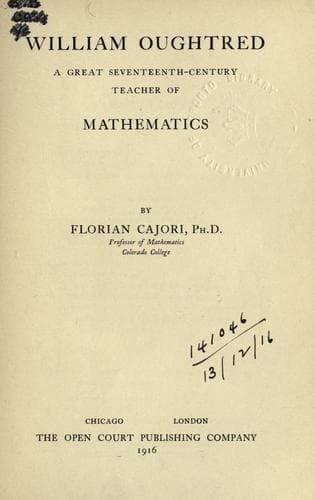
William Oughtred: A Great Seventeenth-Century Teacher of Mathematics — John Shaqi
William Oughtred: A Great Seventeenth-Century Teacher of MathematicsCajori, Florian
History
William Oughtred: A Great Seventeenth-Century Teacher of Mathematics
Cajori, Florian
Mathematicians -- Biography; Mathematics -- Study and teaching -- History -- 17th century; Oughtred, William, 1575-1660
The Clavis opens with an explanation of the Hindu-Arabic notation and of
decimal fractions. Noteworthy is the absence of the words “million,”
“billion,” etc. Though used on the Continent by certain mathematical
writers long before this, these words did not become current in English
mathematical books until the eighteenth century. The author was a great
admirer of decimal fractions, but failed to introduce the notation which
in later centuries came to be universally adopted. Oughtred wrote 0.56 in
this manner 0|56; the point he used to designate ratio. Thus 3:4 was
written by him 3·4. The decimal point (or comma) was first used by the
inventor of logarithms, John Napier, as early as 1616 and 1617. Although
Oughtred had mastered the theory of logarithms soon after their
publication in 1614 and was a great admirer of Napier, he preferred to
use the dot for the designation of ratio. This notation of ratio is used
in all his mathematical books, except in two instances. The two dots (:)
occur as symbols of ratio in some parts of Oughtred’s posthumous work,
Opuscula mathematica hactenus inedita, Oxford, 1677, but may have been
due to the editors and not to Oughtred himself. Then again the two dots
(:) are used to designate ratio on the last two pages of the tables of
the Latin edition of Oughtred’s Trigonometria of 1657. In all other parts
of that book the dot (·) is used. Probably someone who supervised the
printing of the tables introduced the (:) on the last two pages,
following the logarithmic tables, where methods of interpolation are
explained. The probability of this conjecture is the stronger, because in
the English edition of the Trigonometrie, brought out the same year
(1657) but after the Latin edition, the notation (:) at the end of the
book is replaced by the usual (·), except that in some copies of the
English edition the explanations at the end are omitted altogether.
Public-domain text, read in full here on John Shaqi.
Reviews
Reviews
No reviews yet
Be the first to share your thoughts on this work.
Join the Discussion
Join the discussion
Sign in to leave a comment or review.
Sign InorCreate an account