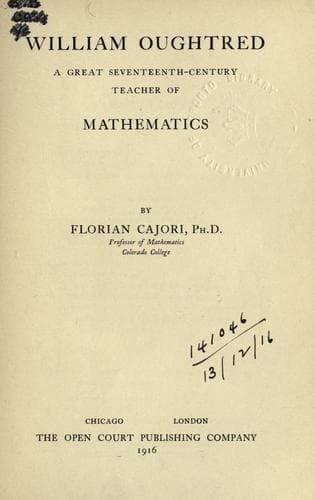
William Oughtred: A Great Seventeenth-Century Teacher of Mathematics — John Shaqi
William Oughtred: A Great Seventeenth-Century Teacher of MathematicsCajori, Florian
History
William Oughtred: A Great Seventeenth-Century Teacher of Mathematics
Cajori, Florian
Mathematicians -- Biography; Mathematics -- Study and teaching -- History -- 17th century; Oughtred, William, 1575-1660
A word should be said on Oughtred’s definition of + and -. He recognizes
their double function in algebra by saying (Clavis, 1631, p. 2): “Signum
additionis, sive affirmationis, est + plus” and “Signum subductionis,
sive negationis est - minus.” They are symbols which indicate the quality
of numbers in some instances and operations of addition or subtraction in
other instances. In the 1694 edition of the Clavis, thirty-four years
after the death of Oughtred, these symbols are defined as signifying
operations only, but are actually used to signify the quality of numbers
as well. In this respect the 1694 edition marks a recrudescence.
The characteristic in the Clavis that is most striking to a modern reader
is the total absence of indexes or exponents. There is much discussion in
the leading treatises of the latter part of the sixteenth and the early
part of the seventeenth century on the theory of indexes, but the modern
exponential notation, aⁿ, is of later date. The modern notation, for
positive integral exponents, first appears in Descartes’ Géométrie, 1637;
fractional and negative exponents were first used in the modern form by
Sir Isaac Newton, in his announcement of the binomial formula, in a
letter written in 1676. This total absence of our modern exponential
notation in Oughtred’s Clavis gives it a strange aspect. Like Vieta,
Oughtred uses ordinarily the capital letters, A, B, C, . . . . to
designate given numbers; A² is written Aq, A³ is written Ac; for A⁴, A⁵,
A⁶ he has, respectively, Aqq, Aqc, Acc. Only on rare occasions, usually
when some parallelism in notation is aimed at, does he use small
letters[27] to represent numbers or magnitudes. Powers of binomials or
polynomials are marked by prefixing the capital letters Q (for square), C
(for cube), QQ (for the fourth power), QC (for the fifth power), etc.
Public-domain text, read in full here on John Shaqi.
Reviews
Reviews
No reviews yet
Be the first to share your thoughts on this work.
Join the Discussion
Join the discussion
Sign in to leave a comment or review.
Sign InorCreate an account