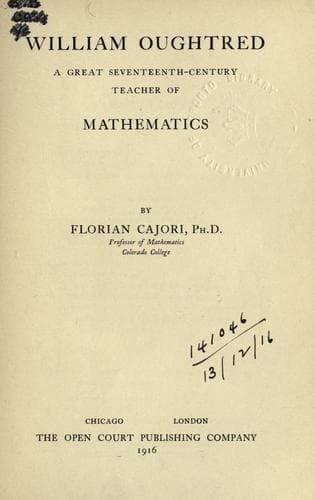
William Oughtred: A Great Seventeenth-Century Teacher of MathematicsCajori, Florian
History
William Oughtred: A Great Seventeenth-Century Teacher of Mathematics
Cajori, Florian
Mathematicians -- Biography; Mathematics -- Study and teaching -- History -- 17th century; Oughtred, William, 1575-1660
Oughtred gives two processes of long division. The first is identical
with the modern process, except that the divisor is written below every
remainder, each digit of the divisor being crossed out as soon as it has
been used in the partial multiplication. The second method of long
division is one of the several types of the old “scratch method.” This
antiquated process held its place by the side of the modern method in all
editions of the Clavis. The author divides 467023 by 357|0926425, giving
the following instructions: “Take as many of the first Figures of the
Divisor as are necessary, for the first Divisor, and then in every
following particular Division drop one of the Figures of the Divisor
towards the Left Hand, till you have got a competent Quotient.” He does
not explain abbreviated division as thoroughly as abbreviated
multiplication.
17
3̸0̸3̸
2̸8̸0̸3̸
1̸0̸9̸9̸3̸0̸
3̣5̣7̣|0̣9̣2̣6425) 4̸6̸7̸0̸2̸3̸ (1307|80
3̸5̸7̸0̸9̸3̸
1̸0̸7̸1̸2̸7̸
2̸5̸0̸0̸
2̸8̸6̸
Oughtred does not examine the degree of reliability or accuracy of his
processes of abbreviated multiplication and division. Here as in other
places he gives in condensed statement the mode of procedure, without
further discussion.
He does not attempt to establish the rules for the addition, subtraction,
multiplication, and division of positive and negative numbers. “If the
Signs are both alike, the Product will be affirmative, if unlike,
negative”; then he proceeds to applications. This attitude is superior to
that of many writers of the eighteenth and nineteenth centuries, on
pedagogical as well as logical grounds: pedagogically, because the
beginner in the study of algebra is not in a position to appreciate an
abstract train of thought, as every teacher well knows, and derives
better intellectual exercise from the applications of the rules to
problems; logically, because the rule of signs in multiplication does not
admit of rigorous proof, unless some other assumption is first made which
is no less arbitrary than the rule itself. It is well known that the
proofs of the rule of signs given by eighteenth-century writers are
invalid. Somewhere they involve some surreptitious assumption. This
criticism applies even to the proof given by Laplace, which tacitly
assumes the distributive law in multiplication.
Public-domain text, read in full here on John Shaqi.
Reviews
Reviews
No reviews yet
Be the first to share your thoughts on this work.
Join the Discussion
Join the discussion
Sign in to leave a comment or review.
Sign InorCreate an account