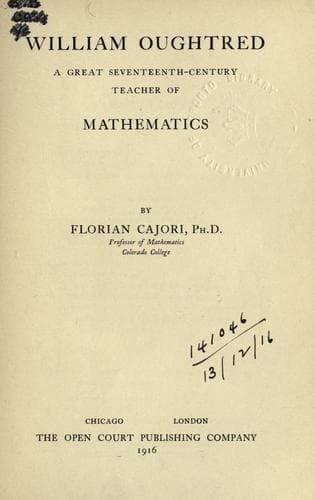
William Oughtred: A Great Seventeenth-Century Teacher of MathematicsCajori, Florian
History
William Oughtred: A Great Seventeenth-Century Teacher of Mathematics
Cajori, Florian
Mathematicians -- Biography; Mathematics -- Study and teaching -- History -- 17th century; Oughtred, William, 1575-1660
The half of the middle species is Z/2 (5), its square is Z²/4 (25).
From it subtract the absolute term AE (21), and Z²/4-AE (4) will be the
square of half the difference of the segments. The square root of this,
√[(Z²/2)²-AE] (2), is half the difference. If you add it to half the
coefficient Z/2 (5), or half the line to be bisected, the longer
segment is obtained; if you subtract it, the smaller segment is
obtained. I say: Z/2±√(Z²/4-AE)=A {major segment/minor segment.
The quadratic equation Aq+ZA=AE receives similar treatment. This and the
preceding equation, ZA-Aq=AE, constitute together a solution of the
general quadratic equation, x²+ax=b, provided that E or Z are not
restricted to positive values, but admit of being either positive or
negative, a case not adequately treated by Oughtred. Imaginary numbers
and imaginary roots receive no consideration whatever.
A notation suggested by Vieta and favored by Girard made vowels stand for
unknowns and consonants for knowns. This conventionality was adopted by
Oughtred in parts of his algebra, but not throughout. Near the beginning
he used Q to designate the unknown, though usually this letter stood with
him for the “square” of the expression after it.[34]
It is of some interest that Oughtred used π/δ to signify the ratio of the
circumference to the diameter of a circle. Very probably this notation is
the forerunner of the π=3.14159 . . . . used in 1706 by William Jones.
Oughtred first used π/δ in the 1647 edition of the Clavis mathematicae.
In the 1652 edition he says, “Si in circulo sit 7.22::δ·π::113.355:erit
δ·π::2 R.P: periph.” This notation was adopted by Isaac Barrow, who used
it extensively. David Gregory[35] used π/ρ in 1697, and De Moivre[36]
used c/r about 1697, to designate the ratio of the circumference to the
radius.
We quote the description of the Clavis that was given by Oughtred’s
greatest pupil, John Wallis. It contains additional information of
interest to us. Wallis devotes chap. xv of his Treatise of Algebra,
London, 1685, pp. 67-69, to Mr. Oughtred and his Clavis, saying:
Mr. William Oughtred (our Country-man) in his Clavis Mathematicae, (or
Key of Mathematicks,) first published in the Year 1631, follows Vieta
(as he did Diophantus) in the use of the Cossick Denominations;
omitting (as he had done) the names of Sursolids, and contenting
himself with those of Square and Cube, and the Compounds of these.
But he doth abridge Vieta’s Characters or Species, using only the
letters q, c, &c. which in Vieta are expressed (at length) by Quadrate,
Cube, &c. For though when Vieta first introduced this way of Specious
Arithmetick, it was more necessary (the thing being new,) to express it
in words at length: Yet when the thing was once received in practise,
Mr. Oughtred (who affected brevity, and to deliver what he taught as
briefly as might be, and reduce all to a short view,) contented himself
with single Letters instead of those words.
Public-domain text, read in full here on John Shaqi.
Reviews
Reviews
No reviews yet
Be the first to share your thoughts on this work.
Join the Discussion
Join the discussion
Sign in to leave a comment or review.
Sign InorCreate an account