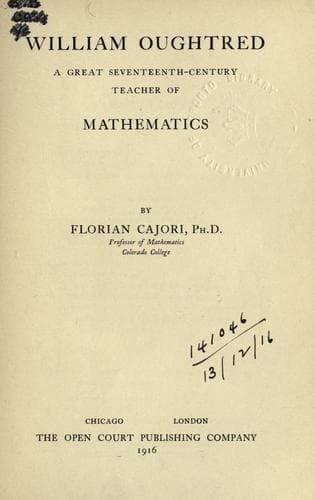
William Oughtred: A Great Seventeenth-Century Teacher of Mathematics — John Shaqi
William Oughtred: A Great Seventeenth-Century Teacher of MathematicsCajori, Florian
History
William Oughtred: A Great Seventeenth-Century Teacher of Mathematics
Cajori, Florian
Mathematicians -- Biography; Mathematics -- Study and teaching -- History -- 17th century; Oughtred, William, 1575-1660
Thus what Vieta would have written
A Quadrate, into B Cube,
------------------------ Equal to FG Plane,
CDE Solid,
would with him be thus expressed
A_q B_c
------- = FG.
C D E
And the better to distinguish upon the first view, what quantities were
Known, and what Unknown, he doth (usually) denote the Known to
Consonants, and the Unknown by Vowels; as Vieta (for the same reason)
had done before him.
He doth also (to very great advantage) make use of several Ligatures,
or Compendious Notes, to signify Summs, Differences, and Rectangles of
several Quantities. As for instance, Of two Quantities A (the Greater),
and E (the Lesser), the Sum he calls Z, the Difference X, the Rectangle
AE. . . . .
Which being of (almost) a constant signification with him throughout,
do save a great circumlocution of words, (each Letter serving instead
of a Definition;) and are also made use of (with very great advantage)
to discover the true nature of divers intricate Operations, arising
from the various compositions of such Parts, Sums, Differences, and
Rectangles; (of which there is great plenty in his Clavis, Cap. 11, 16,
18, 19. and elsewhere,) which without such Ligatures, or Compendious
Notes, would not be easily discovered or apprehended. . . . .
I know there are who find fault with his Clavis, as too obscure,
because so short, but without cause; for his words be always full, but
not Redundant, and need only a little attention in the Reader to weigh
the force of every word, and the Syntax of it; . . . . And this, when
once apprehended, is much more easily retained, than if it were
expressed with the prolixity of some other Writers; where a Reader must
first be at the pains to weed out a great deal of superfluous Language,
that he may have a short prospect of what is material; which is here
contracted for him in a short Synopsis. . . . .
Public-domain text, read in full here on John Shaqi.
Reviews
Reviews
No reviews yet
Be the first to share your thoughts on this work.
Join the Discussion
Join the discussion
Sign in to leave a comment or review.
Sign InorCreate an account