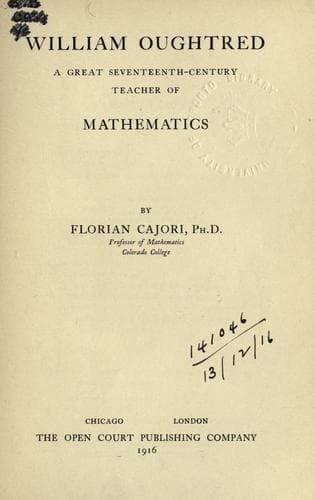
William Oughtred: A Great Seventeenth-Century Teacher of MathematicsCajori, Florian
History
William Oughtred: A Great Seventeenth-Century Teacher of Mathematics
Cajori, Florian
Mathematicians -- Biography; Mathematics -- Study and teaching -- History -- 17th century; Oughtred, William, 1575-1660
Mention should be made of trigonometric symbols used even earlier than
any of the preceding, in “An Appendix to the Logarithmes, shewing the
practise of the Calculation of Triangles, etc.,” printed in Edward
Wright’s edition of Napier’s A Description of the Admirable Table of
Logarithmes, London, 1618. We referred to this “Appendix” in tracing the
origin of the sign ×. It contains, on p. 4, the following passage: “For
the Logarithme of an arch or an angle I set before (s), for the
antilogarithme or compliment thereof (s*) and for the Differential (t).”
In further explanation of this rather unsatisfactory passage, the author
(Oughtred?) says, “As for example: sB+BC=CA. that is, the Logarithme of
an angle B. at the Base of a plane right-angled triangle, increased by
the addition of the Logarithm of BC, the hypothenuse thereof, is equall
to the Logarithme of CA the cathetus.”
Here “logarithme of an angle B” evidently means “log sin B,” just as with
Napier, “Logarithms of the arcs” signifies really “Logarithms of the
sines of the angles.” In Napier’s table, the numbers in the column marked
“Differentiae” signify log sine minus log cosine of an angle; that is,
the logarithms of the tangents. This explains the contraction (t) in the
“Appendix.” The conclusion of all this is that as early as 1618 the signs
s, s*, t were used for sine, cosine, and tangent, respectively.
John Speidell, in his Breefe Treatise of Sphaericall Triangles, London,
1627, uses Si. for sine, T. and Tan for tangent, Se. for secant, Si. Co.
for cosine, Se. Co. for cosecant, T. Co. for cotangent.
The innovation of designating the sides and angles of a triangle by A, B,
C, and a, b, c, so that A was opposite a, B opposite b, and C opposite c,
is attributed to Leonard Euler (1753), but was first used by Richard
Rawlinson of Queen’s College, Oxford, sometimes after 1655 and before
1668. Oughtred did not use Rawlinson’s notation.[43]
In trigonometry English writers of the first half of the seventeenth
century used contractions more freely than their continental
contemporaries; even more freely, indeed, than English writers of a later
period. Von Braunmühl, the great historian of trigonometry, gives
Oughtred much praise for his trigonometry, and points out that half a
century later the army of writers on trigonometry had hardly yet reached
the standard set by Oughtred’s analysis.[44] Oughtred must be credited
also with the first complete proof that was given to the first two of
“Napier’s analogies.” His trigonometry contains seven-place tables of
sines, tangents, and secants, and six-place tables of logarithmic sines
and tangents; also seven-place logarithmic tables of numbers. At the time
of Oughtred there was some agitation in favor of a wider introduction of
decimal systems. This movement is reflected in those tables which contain
the centesimal division of the degree, a practice which is urged for
general adoption in our own day, particularly by the French.
Public-domain text, read in full here on John Shaqi.
Reviews
Reviews
No reviews yet
Be the first to share your thoughts on this work.
Join the Discussion
Join the discussion
Sign in to leave a comment or review.
Sign InorCreate an account