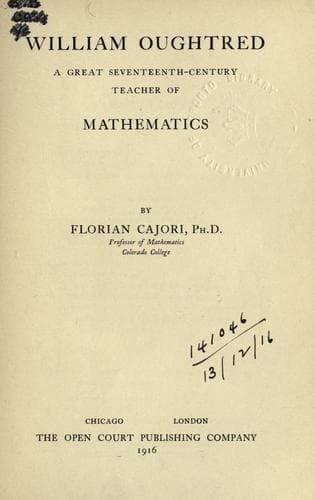
William Oughtred: A Great Seventeenth-Century Teacher of Mathematics — John Shaqi
William Oughtred: A Great Seventeenth-Century Teacher of MathematicsCajori, Florian
History
William Oughtred: A Great Seventeenth-Century Teacher of Mathematics
Cajori, Florian
Mathematicians -- Biography; Mathematics -- Study and teaching -- History -- 17th century; Oughtred, William, 1575-1660
SOLUTION OF NUMERICAL EQUATIONS
In the solution of numerical equations Oughtred does not mention the
sources from which he drew, but the method is substantially that of the
great French algebraist Vieta, as explained in a publication which
appeared in 1600 in Paris under the title, De numerosa potestatum purarum
atque adfectarum ad exegesin resolutione tractatus. In view of the fact
that Vieta’s process has been described inaccurately by leading modern
historians including H. Hankel[45] and M. Cantor,[46] it may be worth
while to go into some detail.[47] By them it is made to appear as
identical with the procedure given later by Newton. The two are not the
same. The difference lies in the divisor used. What is now called
“Newton’s method” is Newton’s method as modified by Joseph Raphson.[48]
The Newton-Raphson method of approximation to the roots of an equation
f(x)=0 is usually given the form a-[f(a)/f´(a)], where a is an
approximate value of the required root. It will be seen that the divisor
is f´(a). Vieta’s divisor is different; it is
|f(a+s₁)-f(a)|-s₁ⁿ,
where f(x) is the left of the equation f(x)=k, n is the degree of
equation, and s₁ is a unit of the denomination of the digit next to be
found. Thus in x³+420000x=247651713, it can be shown that 417 is
approximately a root; suppose that a has been taken to be 400, then
s₁=10; but if, at the next step of approximation, a is taken to be 410,
then s₁=1. In this example, taking a=400, Vieta’s divisor would have been
9120000; Newton’s divisor would have been 900000.
A comparison of Vieta’s method with the Newton-Raphson method reveals the
fact that Vieta’s divisor is more reliable, but labors under the very
great disadvantage of requiring a much larger amount of computation. The
latter divisor is accurate enough and easier to compute. Altogether the
Newton-Raphson process marks a decided advance over that of Vieta.
As already stated, it is the method of Vieta that Oughtred explains. The
Englishman’s exposition is an improvement on that of Vieta, printed forty
years earlier. Nevertheless, Oughtred’s explanation is far from easy to
follow. The theory of equations was at that time still in its primitive
stage of development. Algebraic notation was not sufficiently developed
to enable the argument to be condensed into a form easily surveyed. So
complicated does Vieta’s process of approximation appear that M. Cantor
failed to recognize that Vieta possessed a uniform mode of procedure. But
when one has in mind the general expression for Vieta’s divisor which we
gave above, one will recognize that there was marked uniformity in
Vieta’s approximations.
Oughtred allows himself twenty-eight sections in which to explain the
process and at the close cannot forbear remarking that 28 is a “perfect”
number (being equal to the sum of its divisors, 1, 2, 4, 7, 14).
Public-domain text, read in full here on John Shaqi.
Reviews
Reviews
No reviews yet
Be the first to share your thoughts on this work.
Join the Discussion
Join the discussion
Sign in to leave a comment or review.
Sign InorCreate an account