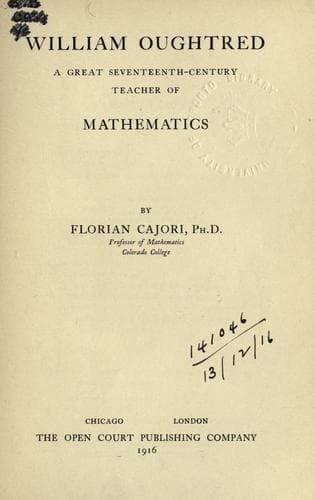
William Oughtred: A Great Seventeenth-Century Teacher of MathematicsCajori, Florian
History
William Oughtred: A Great Seventeenth-Century Teacher of Mathematics
Cajori, Florian
Mathematicians -- Biography; Mathematics -- Study and teaching -- History -- 17th century; Oughtred, William, 1575-1660
These words describe the struggles which every youth not endowed with the
highest genius must make to achieve success. They show, moreover, the
kindly feeling toward others and the delight he took throughout life in
assisting anyone interested in mathematics. Oughtred’s passion for this
study is the more remarkable as neither at Eton nor at Cambridge did it
receive emphasis. Even after his time at Cambridge mathematical studies
and their applications were neglected there. Jeremiah Horrox was at
Cambridge in 1633-35, desiring to make himself an astronomer.
“But many impediments,” says Horrox, “presented themselves: the tedious
difficulty of the study itself deterred a mind not yet formed; the want
of means oppressed, and still oppresses, the aspirations of my mind:
but that which gave me most concern was that there was no one who could
instruct me in the art, who could even help my endeavours by joining me
in the study; such was the sloth and languor which had seized all. . .
. . I found that books must be used instead of teachers.”[3]
Some attention was given to Greek mathematicians, but the works of
Italian, German, and French algebraists of the latter part of the
sixteenth and beginning of the seventeenth century were quite unknown at
Cambridge in Oughtred’s day. It was part of his life-work as a
mathematician to make algebra, as it was being developed in his time,
accessible to English youths.
At the age of twenty-three Oughtred invented his Easy Way of Delineating
Sun-Dials by Geometry, which, though not published until about half a
century later, in the first English edition of Oughtred’s Clavis
mathematicae in 1647, was in the meantime translated into Latin by
Christopher Wren, then a Gentleman Commoner of Wadham College, Oxford,
now best known through his architectural creations. In 1600 Oughtred
wrote a monograph on the construction of sun-dials upon a plane of any
inclination, but that paper was withheld by him from publication until
1632. Sun-dials were interesting objects of study, since watches and
pendulum clocks were then still unknown. All sorts of sun-dials, portable
and non-portable, were used at that time and long afterward. Several of
the college buildings at Oxford and Cambridge have sun-dials even at the
present time.
AS RECTOR AND AMATEUR MATHEMATICIAN
It was in 1604 that Oughtred entered upon his professional life-work as a
preacher, being instituted to the vicarage of Shalford in Surrey. In 1610
he was made rector of Albury, where he spent the remainder of his long
life. Since the era of the Reformation two of the rectors of Albury
obtained great celebrity from their varied talents and acquirements—our
William Oughtred and Samuel Horsley. Oughtred continued to devote his
spare time to mathematics, as he had done in college. A great
mathematical invention made by a Scotchman soon commanded his
attention—the invention of logarithms. An informant writes as follows:
Public-domain text, read in full here on John Shaqi.
Reviews
Reviews
No reviews yet
Be the first to share your thoughts on this work.
Join the Discussion
Join the discussion
Sign in to leave a comment or review.
Sign InorCreate an account