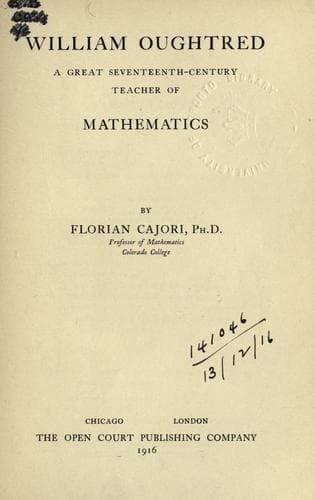
William Oughtred: A Great Seventeenth-Century Teacher of MathematicsCajori, Florian
History
William Oughtred: A Great Seventeenth-Century Teacher of Mathematics
Cajori, Florian
Mathematicians -- Biography; Mathematics -- Study and teaching -- History -- 17th century; Oughtred, William, 1575-1660
Lord Napier, in 1614, published at Edinburgh his Mirifici logarithmorum
canonis descriptio. . . . . It presently fell into the hands of Mr.
Briggs, then geometry-reader at Gresham College in London: and that
gentleman, forming a design to perfect Lord Napier’s plan, consulted
Oughtred upon it; who probably wrote his Treatise of Trigonometry about
the same time, since it is evidently formed upon the plan of Lord
Napier’s Canon.[4]
It will be shown later that Oughtred is very probably the author of an
“Appendix” which appeared in the 1618 edition of Edward Wright’s
translation into English of John Napier’s Descriptio. This “Appendix”
relates to logarithms and is an able document, containing several points
of historical interest. Mr. Arthur Hutchinson of Pembroke College informs
me that in the university library at Cambridge there is a copy of
Napier’s Constructio (1619) bound up with a copy of Kepler’s Chilias
logarithmorum (1624), that at the beginning of the Constructio is a blank
leaf, and before this occurs the title-page only of Napier’s Descriptio
(1619), at the top of which appears Oughtred’s autograph. The history of
this interesting signature is unknown.
HIS WIFE
In 1606 he married Christ’sgift Caryll, daughter of Caryll, Esq., of
Tangley, in an adjoining parish.[5] We know very little about Oughtred’s
family life. The records at King’s College, Cambridge,[6] mention a son,
but it is certain that there were more children. A daughter was married
to Christopher Brookes. But there is no confirmation of Aubrey’s
statements,[7] according to which Oughtred had nine sons and four
daughters. Reference to the wife and children is sometimes made in the
correspondence with Oughtred. In 1616 J. Hales writes, “I pray let me be
remembered, though unknown, to Mistress Oughtred.”[8]
As we shall see later, Oughtred had a great many young men who came to
his house and remained there free of charge to receive instruction in
mathematics, which was likewise gratuitous. This being the case,
certainly great appreciation was due to Mrs. Oughtred, upon whom the
burden of hospitality must have fallen. Yet chroniclers are singularly
silent in regard to her. Hers was evidently a life of obscurity and
service. We greatly doubt the accuracy of the following item handed down
by Aubrey; it cannot be a true characterization:
His wife was a penurious woman, and would not allow him to burne candle
after supper, by which meanes many a good notion is lost, and many a
probleme unsolved; so that Mr. [Thomas] Henshawe, when he was there,
bought candle, which was a great comfort to the old man.[9]
IN DANGER OF SEQUESTRATION
Oughtred spent his years in “unremitted attention to his favourite
study,” sometimes, it has been whispered, to the neglect of his rectorial
duties. Says Aubrey:
Public-domain text, read in full here on John Shaqi.
Reviews
Reviews
No reviews yet
Be the first to share your thoughts on this work.
Join the Discussion
Join the discussion
Sign in to leave a comment or review.
Sign InorCreate an account