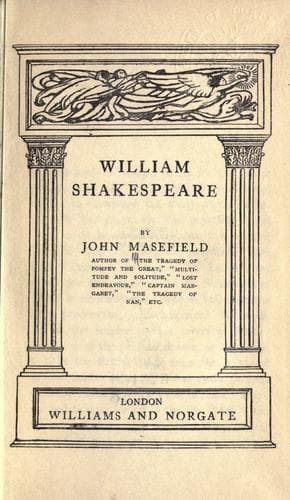
Shakespeare, William, 1564-1616 -- Criticism and interpretation
This gentle, bewildered soul makes the only human remarks in the play.
In Shakespeare's vision it is from such souls, planted, to their own
misery, among spikes and thorns, that the flower of human goodness
blossoms.
_King Henry VI, Part III._
_Written._ (?)
_Published_, in the crude original form, 1595. When first
published, the play was called "The True Tragedie of Richard Duke
of Yorke, and the Death of good King Henrie the Sixt, with the
whole contention betweene the two Houses of Lancaster and Yorke."
This version seems to have been by Greene, Peele, Marlowe, or by
some combination among the three. There are some marks of
Shakespeare's hand upon it; but not many. Afterwards the piece was
revised and enlarged to its present form by some unknown hand.
Shakespeare added a few touches to this revision. It was printed in
the first folio as his original work.
_Source of the Plot._ Edward Hall's _Chronicle_. Raphael
Holinshed's _Chronicle_.
_The Fable._ The play describes the rise to power of Edward, Duke
of York, afterwards Edward IV. It carries on the story of the reign
of Henry VI from the time of his deposition by Richard, Duke of
York, to the time of his murder by Richard, Duke of Gloucester.
Various other tragedies are developed by the plot. Richard, Duke of
York, is defeated and put to death. The Earl of Warwick rises to
power, makes Edward, Duke of York, King, revolts from him, restores
Henry VI, is attacked, defeated, and killed in battle. Richard,
Duke of Gloucester, begins to cherish ambition, and sets bloodily
to work to gratify it. Edward, Duke of York, after one deposition,
due to his own treachery, obtains the supreme power, and rules as
King.
Shakespeare had little hand in this ruthless chronicle. The idea of the
piece seems to be this, that--
"It is war's prize to take all vantages,"
that mercy has no place in war, that an act of mercy in war is more
fatal than defeat, and that the parfit gentle knight, if he wish to
prosper, must greet his father after battle with some such remark as--
"I cleft his beaver with a downright blow;
That this is true, father, behold his blood."
There are three scenes that rouse human emotion: that in Act I, sc. iv,
where Margaret of Anjou taunts the captured York before putting him to
death; that in Act II, sc. v, where King Henry wishes himself either
dead, or called to some gentler trade than kingship; and that at the
end, after the battle of Tewkesbury, where the Prince of Wales is
murdered in his mother's presence. The second of these, the lamentation
of King Henry, is an enlargement, done in leisure, from a suggestion in
the early version. It is a very beautiful example of the quiet, limpid
running rhetoric that marks Shakespeare's best moments in the days
before he attained to power.
Public-domain text, read in full here on John Shaqi.
Reviews
Reviews
No reviews yet
Be the first to share your thoughts on this work.
Join the Discussion
Join the discussion
Sign in to leave a comment or review.
Sign InorCreate an account