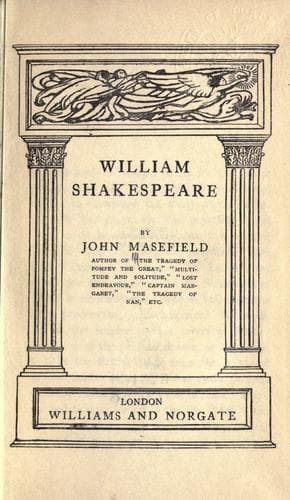
Shakespeare, William, 1564-1616 -- Criticism and interpretation
"So minutes, hours, days, moneths and years,
Pass'd over to the end they were created,
Would bring white hairs unto a quiet grave.
Ah, what a life were this. How sweet. How lovely.
Gives not the hawthorn-bush a sweeter shade
To shepherds looking on their silly sheep,
Than doth a rich-embroidered canopy
To kings that fear their subjects' treachery."
_A Midsummer Night's Dream._
_Written._ 1595 (?)
_Published._ 1600.
_Source of the Plot._ The fantasy is of Shakespeare's making. Some
of it was perhaps current in popular belief. Names and lesser
incidents were suggested by various books. He took little bits from
various sources, added them to the vision, and turned upon the
whole the light of his mind. If any author laid under contribution
were to recognise his bantling, he could only cry to it, "Bless
thee, Bottom, thou art translated." Shakespeare did never this
particular kind of wrong but with just cause.
_The Fable._ Theseus, Duke of Athens, is about to marry Hippolyta.
Bottom, the weaver, and his friends, plan to play the tragedy of
Pyramus and Thisbe before the Duke after the wedding.
Hermia and Lysander, two lovers, whose match is opposed, plan to
escape from Athens to a state where they can marry.
Demetrius, in love with Hermia, is loved by Helena.
Oberon, King of the fairies, planning to punish his Queen Titania,
orders Puck to procure a juice that will make her dote upon the
next thing seen by her.
Helena pursues Demetrius into the wood of the fairies. Titania,
anointed with the juice, falls in love with Bottom. Lysander,
anointed with the juice, falls in love with Helena. The confusion
caused by these enchantments (accidentally) makes the main action
of the play. When the purpose of Oberon is satisfied, the
enchantments are removed. The cross purposes of the lovers cease.
Theseus causes Hermia to wed Lysander, and Helena to wed Demetrius.
Bottom and his company perform their tragedy, and all ends happily.
It is a strange and sad thing that the English poets have cared little
for England; or, caring for England, have had little sense of the spirit
of the English. Many of our poets have written botanical verses, and
braggart verses, many more have described faithfully the appearance of
parts of the land at different seasons. Only two or three show the
mettle of their pasture in such a way that he who reads them can be sure
that the indefinable soul of England has given their words something
sacred and of the land.
Public-domain text, read in full here on John Shaqi.
Reviews
Reviews
No reviews yet
Be the first to share your thoughts on this work.
Join the Discussion
Join the discussion
Sign in to leave a comment or review.
Sign InorCreate an account