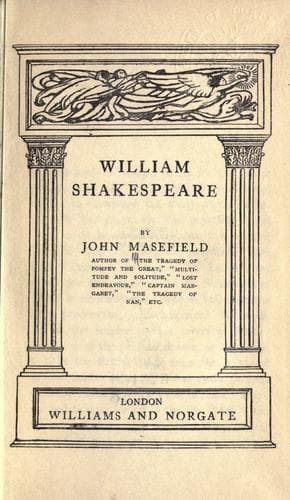
Shakespeare, William, 1564-1616 -- Criticism and interpretation
In the historical plays, Shakespeare's mind broods on the idea that our
tragical kings failed because they did not conform to a type lower than
themselves. Henry V conforms to type. He has the qualities that impress
the bourgeoisie. He is a success. Henry VI does not conform to type. He
has the qualities of the Christian mystic. He is stabbed in the Tower.
Edward IV conforms to type. He has the qualities that impress the
rabble. He is a success. Richard II does not conform to type. He is a
man of ideas. He is done to death at Pomfret. King John does not conform
to type. His intellect is bigger than his capacity for affairs. He is
poisoned by a monk at Swinstead.
King John presents that most subtle of all the images of treachery, a
man who cannot conform to the standard of his own ideas. He fails as a
king because his intellect prompts him to attempt what is really beyond
the powers of his nature to perform. By his side, with an irony that is
seldom praised, Shakespeare places the figure of the Bastard, the man
who ought to have been king, the man fitted by nature to rule the
English, the man without intellect but with a rough capacity, the man
whom we meet again, as a successful king, in the play of _Henry V_.
King John is placed throughout the play in treacherous relations with
life. He is a traitor to his brother's son, to his own ideas, to the
English idea, and to his oath of kingship. He has a bigger intellect
than any one about him. His brain is full of gusts and flaws that blow
him beyond his age, and then let him sink below it. Persistence in any
one course of treachery would give him the greatness of all well-defined
things. He remains a chaos shooting out occasional fire.
The play opens with a scene that displays some of the human results of
treachery. John's mother, Elinor, has been treacherous to one of her
sons. John has usurped his brother's right, and, in following his own
counsel, has been treacherous to his mother. These acts of treachery
have betrayed England into a bloody and unjust war. The picture is
turned suddenly. Another of the results of human treachery appears in
the person of the Bastard, whose mother confesses that she was seduced
by the "long and vehement suit" of Coeur de Lion. The Bastard's
half-brother, another domestic traitor, does not scruple to accuse his
mother of adultery in the hope that, by doing so, he may obtain the
Bastard's heritage.
Public-domain text, read in full here on John Shaqi.
Reviews
Reviews
No reviews yet
Be the first to share your thoughts on this work.
Join the Discussion
Join the discussion
Sign in to leave a comment or review.
Sign InorCreate an account