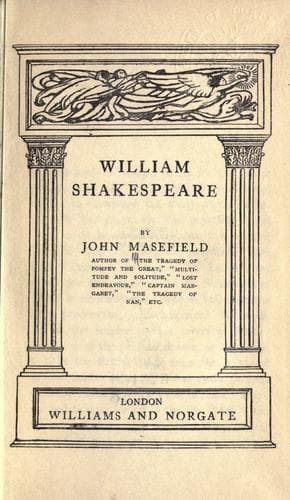
Shakespeare, William, 1564-1616 -- Criticism and interpretation
It is a proof of the greatness of Shakespeare's vision, that Richard is
presented to us both as the traitor and the betrayed. He is the anointed
king false to his coronation oaths; he is the anointed king deposed by
traitors. He is not fitted for kingship, but life has made him a king.
Life, quite as much as temperament, is to blame for his tragedy. When
life and temperament have thrust him from kingship, this wilful,
passionate man, so greedy and heady in his hurry to be unjust, is unlike
the monster that office made him. He is no monster then, but a man, not
even a man like ourselves, but a man of singular delicacy of mind,
sensitive, strangely winning, who wrings our hearts with pity by his
sense of his tragedy--
"And here have I the daintiness of ear
To check time broke in a disorder'd string;
But for the concord of my state and time
Had not an ear to hear my true time broke."
Part of his tragedy is due to his being too late. Had he landed from
Ireland one day earlier he would have found a force of Welshmen ready to
fight for him. At the end of the play he discovers, too late, that he is
weary of patience. He strikes out like a man, when he has no longer a
friend to strike with him. He is killed by a man who finds, too late,
that the murder was not Bolingbroke's intention.
As in all the tragedies, there is much noble poetry. John of Gaunt's
speech about England is often quoted. Shakespeare's mind is our triumph,
not a dozen lines of rhetoric. Less well known are the couplets--
"My inch of taper will be burnt and done,
And blindfold death not let me see my son."
and
" ... let him not come there,
To seek out sorrow that dwells everywhere."
Those scenes in the last acts which display the mind of the deposed king
are all exquisite, though their beauty is not obvious to the many. There
is a kind of intensity of the soul, so intense that it is obscure to the
many till it is interpreted. Writers of plays know well how tamely words
intensely felt may read. They know, too, how like fire upon many souls
those words will be when the voice and the action give them their
interpretation. _Richard II_, like other plays of spiritual tragedy,
needs interpretation. When he wrote it, Shakespeare had not wholly the
power that afterwards he achieved, of himself interpreting his vision
by many-coloured images. It is not one of the beloved plays.
Bolingbroke has been praised as a manly Englishman, who is not "weak"
like Richard, but "strong" and a man of deeds. In Act IV he shows his
English kindness of mind and love of justice by a temperate wisdom in
the trying of a cause and by saying that he will call back from exile
his old enemy Norfolk. The Bishop of Carlisle tells him that that cannot
be. Norfolk having worn himself out in the wars in Palestine has retired
himself to Italy, and there, at Venice, given
Public-domain text, read in full here on John Shaqi.
Reviews
Reviews
No reviews yet
Be the first to share your thoughts on this work.
Join the Discussion
Join the discussion
Sign in to leave a comment or review.
Sign InorCreate an account