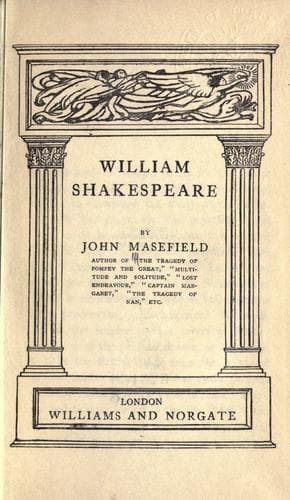
Shakespeare, William, 1564-1616 -- Criticism and interpretation
"His body to that pleasant country's earth,
And his pure soul unto his captain Christ,
Under whose colours he had fought so long."
It is instructive to note how Bolingbroke takes the news--
_Bol._ Why, bishop, is Norfolk dead?
_Carl._ As surely as I live, my lord.
_Bol._ Sweet peace conduct his sweet soul to the bosom
Of good old Abraham. Lords appellants,
Your differences, etc.
The feeling that the poet's mind saw the clash as the clash between the
common and the uncommon man is strengthened by the Queen's speech to
Richard as he is led to prison--
"thou most beauteous inn,
Why should hard-favour'd grief be lodged in thee,
When triumph is become an alehouse guest?"
_King Richard III._
_Written._ 1594 (?)
_Published._ 1597.
_Source of the Plot._ The play is founded on the lives of Edward
IV, Edward V, and Richard III, as given (on the authorities of
Edward Hall and Sir Thomas More) in Holinshed's _Chronicles_.
Shakespeare may have seen a worthless play (_The True Tragedy of
Richard III_) which was published in 1594, by an unknown author.
_The Fable._ Act I. The play begins in the last days of King Edward
IV, when the King's two brothers, Clarence and Gloucester, are
debating who shall succeed to the throne when the King dies. In the
first scene Clarence is led to the Tower under suspicion of
plotting to succeed. Richard, Duke of Gloucester, the cause of the
committal, pretends to grieve for him, but hastens to compass his
death. In the next scene Richard woos the Lady Anne (widow of the
dead son of Henry VI, and daughter of the Earl of Warwick), who is
likely to be useful to him for the moment as an ally (she being of
the house of Lancaster). The third scene displays the passionate
quarrelling of the Court factions. The Queen, her brothers and
Richard's party, are cursed by Margaret of Anjou. In the fourth
scene Clarence is murdered in the Tower.
Act II. King Edward IV dies, having patched up a seeming truce
between the factions. His son is to succeed him. Before this can
happen, Richard strikes down the leaders of the Queen's party, and
lays a deep scheme to secure the crown for himself.
Act III. There is a deeply tragical scene in which the unsuspecting
Hastings, who is faithful to Edward's memory, is hurried out of
life. Afterwards, through the management of Buckingham, Richard is
proclaimed King.
Act IV. Richard makes himself sure by casting off Buckingham and
causing the murder of Edward's sons in the Tower. He plots to marry
Edward's daughter. But by this time the land is in upheaval against
him. Buckingham and Richmond lead forces against him.
Public-domain text, read in full here on John Shaqi.
Reviews
Reviews
No reviews yet
Be the first to share your thoughts on this work.
Join the Discussion
Join the discussion
Sign in to leave a comment or review.
Sign InorCreate an account