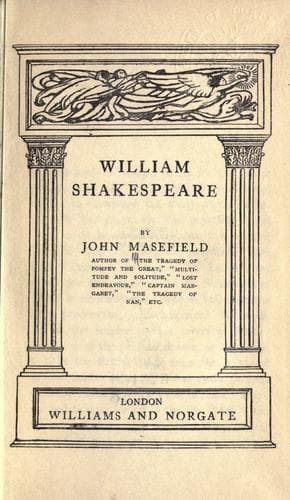
Shakespeare, William, 1564-1616 -- Criticism and interpretation
In the Induction, and in the speech of Biondello (in Act III)
Shakespeare enters a mood of memory of the country. In the song at the
end of _Love's Labour's Lost_ he showed a matchless sense of country
life. That sense, at once robust and sweet, now gives life to a few
scenes in the plays. These scenes are mostly in prose; but they have the
rightness of poetry. In writing them, he wrought with his daily nature,
from something intimately known, or inbred in him, during childhood. Man
can only write happily from a perfect understanding. All men can
describe with point and colour what they knew as children. These country
scenes in Shakespeare are happier than anything else in the plays
because they come, not from anything read or heard, but from the large,
genial nature made by years of life among the farms and sheep-walks at
the western end of the Cotswolds.
_Sly._ Y' are a baggage: the Slys are no rogues; look in the
chronicles; we came in with Richard Conqueror. Therefore _paucas
pallabris_; let the world slide: _Sessa!_
_Hostess._ You will not pay for the glasses you have burst?
_Sly._ No, not a denier. Go by, Jeronimy: go to thy cold bed, and
warm thee.
In the third act, Biondello's description of the appearance of
Petruchio's horse has the abundance of the great mind.
" ... possessed with the glanders and like to mose in the chine;
troubled with the lampass, infected with the fashions, full of
wind-galls, sped with spavins, rayed with the yellows, past cure of
the fives, stark spoiled with the staggers, begnawn with the bots,
swayed in the back and shoulder-shotten; near legged before and
with a half-cheeked bit and a headstall of sheep's leather."
It is something no longer possible in a city theatre. Neither the
dramatist nor the audience of to-day knows a horse as the Elizabethan
had to know him. The speech sets one wondering at the art of the unknown
Elizabethan actor who first spoke hurriedly this speech of strange words
full of sibilants.
Shakespeare's share in the play (the scenes in which the shrew and her
tamer appear) is farce with ironic philosophical intention. He indicates
the tragedy that occurs when a manly spirit is born into a woman's body.
Katharina is vexed and plagued by forced submission to a father who
cannot see her merit, and by jealousy of a gentle, useless sister. She,
who is entirely honest, sees the brainless Bianca, whom no amount of
schooling will make even passably honest, preferred before her. Lastly,
she is humbled into the state of submissive wifely falsehood by a boor
who cares only for his own will, her flesh, and her money. In a page and
a half of melancholy claptrap broken Katharina endeavours to persuade us
that
"Such duty as the subject owes the prince,
Even such a woman oweth to her husband."
Public-domain text, read in full here on John Shaqi.
Reviews
Reviews
No reviews yet
Be the first to share your thoughts on this work.
Join the Discussion
Join the discussion
Sign in to leave a comment or review.
Sign InorCreate an account