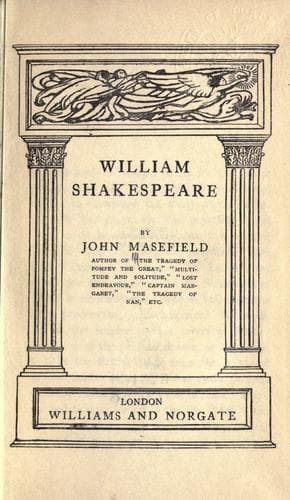
Shakespeare, William, 1564-1616 -- Criticism and interpretation
The play resolves itself into a simple form. It illustrates the clash
between the emotional and the intellectual characters, the man of heart
and the man of brain. The man of heart, Antonio, is obsessed by a
tenderness for his friend. The man of brain is obsessed by a lust to
uphold intellect in a thoughtless world that makes intellect bitter in
every age. Shylock is a man of intellect, born into a despised race. It
is his tragedy that the generous Gentiles about him can be generous to
everything except to intellect and Jewish blood. Intellect and Jewish
blood are too proud to attempt to understand the Gentiles who cannot
understand.
Shylock is a proud man. The Gentiles, who are neither proud nor
intellectual, spit upon him and flout him. One of them beguiles his
daughter and teaches her to rob him. Another of them signs a mad bond to
help an extravagant friend to live in idleness. Bitter, lonely brooding
upon these things strengthen the Jew's obsession, till the words, "I can
cut out the heart of my enemy," become the message of his entire nature.
Half the evils in life come from the partial vision of people in states
of obsession. Shylock's obsession grows till he is in the Duke's court,
whetting his knife upon his shoe, before what Pistol calls "incision."
Portia has been much praised during two centuries of criticism. She is
one of the smiling things created in the large and gentle mood that
moved Shakespeare to comedy. The scene in the fifth act, where the two
women, coming home from Venice by night, see the candle burning in the
hall, as they draw near, is full of a naturalness that makes beauty
quick in the heart. Shakespeare enjoyed the writing of this play. The
construction of the last two acts shows that his great happy mind was at
its happiest in the saving of these creatures of the sun from something
real.
_The Taming of the Shrew._
_Written._ (?)
_Published._ 1623.
_Source of the Plot._ The induction and that part of the play which
treats of Petruchio and Katharina is based upon a play, published
in 1594, under the title _The Taming of A Shrew_, author not known.
The other part is based on _The Supposes_ of George Gascoigne, a
comedy adapted from Ariosto's _I Suppositi_.
_The Fable._ Christopher Sly, a tinker lying drunk by a tavern, is
found by a lord, who causes him to be put to bed and treated, on
waking, as a nobleman newly cured of madness. Part of the treatment
is the performance of this play before him.
The play has two plots. In one of them, Petruchio woos and tames
the shrew Katharina; in the other, Katharina's sister Bianca is
wooed by lovers in disguise. The two plots have little connection
with each other. That which relates to Petruchio and Katharina is
certainly by Shakespeare. The other seems to be by a dull man who
did not know his craft as a dramatist.
Public-domain text, read in full here on John Shaqi.
Reviews
Reviews
No reviews yet
Be the first to share your thoughts on this work.
Join the Discussion
Join the discussion
Sign in to leave a comment or review.
Sign InorCreate an account