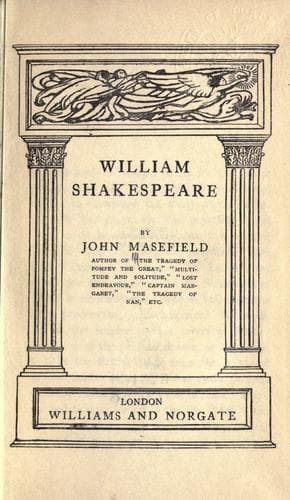
Shakespeare, William, 1564-1616 -- Criticism and interpretation
In this play Shakespeare writes of the power of report, of the thing
overheard, to alter human destiny. Antonio's man, listening behind a
hedge, overhears Don Pedro telling Claudio that he will woo Hero. The
report of his eavesdropping conveys no notion of the truth, and leads,
no doubt, to a bitter moment for Hero. Borachio, hiding behind the
arras, overhears the truth of the matter. The report of his
eavesdropping leads to the casting off of Hero at the altar. Don John
and Borachio vow to Claudio that they overheard Don Pedro making love to
Hero. The report gives Claudio a bitter moment. Benedick, reporting to
the same tune, intensifies his misery.
Benedick, overhearing the report of Beatrice's love for him, changes his
mind about marriage. Beatrice, hearing of Benedick's love for her,
changes her mind about men. Claudio, hearing Don John's report of Hero,
changes his mind about his love. The watch, overhearing Borachio's
report of his villainy, are able to change the tragedy to comedy.
Leonato, hearing Claudio's report of Hero, is ready to cast off his
child. Report is shown to be stronger than any human affection and any
acquired quality, except the love of one unmarried woman for another,
and that strongest of all earthly things, the fool in authority. The
wisdom of Shakespeare is greater and more various than the brains of
little men can imagine. It is one of the tragical things, that this
great man, who interpreted the ways of fate in glorious, many-coloured
vision, should be set aside in our theatres for the mockers and the
accusers, whose vision scatters dust upon the brain and sand upon the
empty heart.
Though the play is not one of the most passionate of the plays, it
belongs to Shakespeare's greatest creative period. It is full of great
and wonderful things. The character-drawing is so abundant and precise
that those who know how hard it is to convey the illusion of character
can only bow down, thankful that such work may be, but ashamed that it
no longer is. Every person in the play is passionately alive about
something. The energy of the creative mood in Shakespeare filled all
these images with a vitality that interests and compels. The wit and
point of the dialogue--
_Don Pedro._ I think this is your daughter.
_Leonato._ Her mother hath many times told me so.
_Benedick._ Were you in doubt, sir, that you asked her?
_Leonato._ Signior Benedick, no; for then you were a child;
or (as in the later passage)--
_Beatrice._ I may sit in a corner and cry heigh ho for a husband.
_Don Pedro._ Lady Beatrice, I will get you one.
_Beatrice._ I would rather have one of your father's getting. Hath
your Grace ne'er a brother like you? Your father got excellent
husbands, if a maid could come by them.
_Don Pedro._ Will you have me, lady?
_Beatrice._ No, my lord, unless I might have another for working
days: your Grace is too costly to wear every day--
Public-domain text, read in full here on John Shaqi.
Reviews
Reviews
No reviews yet
Be the first to share your thoughts on this work.
Join the Discussion
Join the discussion
Sign in to leave a comment or review.
Sign InorCreate an account