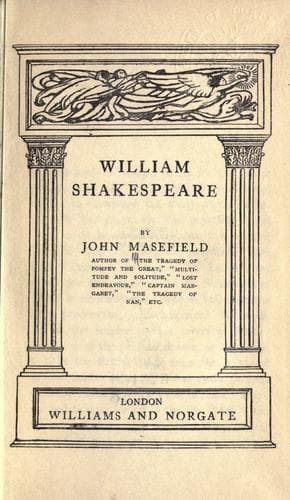
Shakespeare, William, 1564-1616 -- Criticism and interpretation
is plain to all; but it is given to few to see with what admirable,
close, constructive art this dialogue is written for the theatre. Of
poetry, of understanding passionately put, there is comparatively
little. The one great poetical scene is that at the opening of the fifth
act. The worst lines of this scene have become proverbial; the best are
"'tis all men's office to speak patience
To those that wring under the load of sorrow,
But no man's virtue nor sufficiency,
To be so moral when he shall endure
The like himself."
There is little in the play written thus, but there are many scenes
throbbingly alive. The scene in the church shows what power to
understand the awakened imagination has. The scene is a quivering eight
minutes in as many lives. Shakespeare passes from thrilling soul to
thrilling soul with a touch as delicate as it is certain.
Shakespeare's fun is liberally given in the comic scenes. In the last
act there is a beautiful example of the effect of lyric to heighten a
solemn occasion.
_Twelfth Night._
_Written._ 1600 (?)
_Published_, in the first folio, 1623.
_Source of the Plot._ The story of Orsino, Viola, Olivia and
Sebastian is to be found in the "Historie of Apolonius and Silla"
as told by Barnabe Riche in the book _Riche his Farewell to
Militarie Profession_. Riche took the tale from Bandello's Italian,
or from de Belleforest's French translation from it. Three
sixteenth-century Italian plays are based on this fable. All of
these sources may have been known to Shakespeare.
The sub-plot, and the characters contained in it, seem to be
original creations.
_The Fable._ Viola, who thinks that she has lost her brother
Sebastian by shipwreck, disguises herself as a boy, and calls
herself Cesario. She takes service with the Duke Orsino, who is in
love with the lady Olivia. She carries love messages from the Duke
to Olivia.
Olivia, who is in mourning for her brother, refuses the Duke's
suit, but falls in love with Cesario.
In her house is Malvolio, the steward, who reproves her uncle, Sir
Toby Belch, for rioting at night with trivial companions. The
trivial companions forge a letter, which causes Malvolio to think
that his mistress is in love with him. The thought makes his
behaviour so strange that he is locked up as a madman.
Sir Toby Belch finds further solace for life in making his gull,
Sir Andrew, challenge Cesario to a duel. The duel is made dangerous
by the sudden appearance of Sebastian, who is mistaken for Cesario.
He beats Sir Andrew and Sir Toby, and encounters the lady Olivia.
Olivia woos him as she has wooed Cesario, but with better fortune.
Public-domain text, read in full here on John Shaqi.
Reviews
Reviews
No reviews yet
Be the first to share your thoughts on this work.
Join the Discussion
Join the discussion
Sign in to leave a comment or review.
Sign InorCreate an account