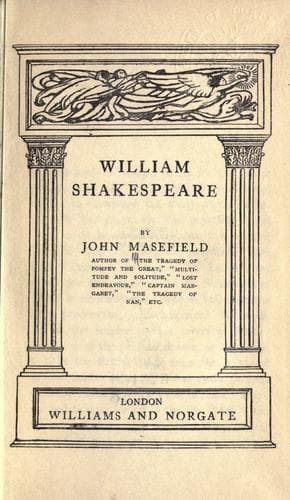
Shakespeare, William, 1564-1616 -- Criticism and interpretation
Shakespeare's abundant power created beings who look before and after,
even while they keep vigorous a passionate present. It is difficult to
praise that power. Even those who know how difficult art is find it hard
to praise perfect art. Art is not to be praised or blamed, but
understood. This play will stand as an example of perfect art till a
greater than Shakespeare set a better example further on. It is
"All beauty and without a spot."
The scene of the roisterers, rousing the night-owl in a catch, rouses
the heart, as all real creation does, with the thought that life is too
wonderful to end. The next, most lovely scene, where the Duke and Viola
talk of love that keeps life from ending, and so often brings life down
into the dust, assures the heart that even if life ends for us it will
go on in others.
"the song we had last night.
Mark it, Cesario, it is old and plain;
The spinsters and the knitters in the sun
And the free maids that weave their thread with bones
Do use to chant it: it is silly sooth,
And dallies with the innocence of love,
Like the old age."
In his best plays Shakespeare used a double construction to express by
turn the twofold energy of man, the energy of the animal and of the
spirit. The mind that brooded sadly in
"For women are as roses, whose fair flower
Being once display'd, doth fall that very hour,"
and in
"She never told her love,
But let concealment, like a worm i' the bud,
Feed on her damask cheek: she pined in thought,"
belonged to earth, and got a gladness from earth. Within two minutes of
the talk of the woman who died of love he showed Contemplation making a
rare turkey-cock of the one wise man in his play.
_All's Well that Ends Well._
_Written._ (?)
_Published._ 1623.
_Source of the Plot._ The story of Helena's love for Bertram is
found in the _Decamerone_ of Boccaccio (giorn. 3, nov. 9).
Shakespeare may have read it in the _Palace of Pleasure_.
_The Fable._ Helena, orphan daughter of a physician, has been
brought up, as a dependant, in the house of the Countess of
Rousillon. She falls in love with Bertram, the son of the Countess
and the King's ward.
Bertram goes to the French Court, on his way to the wars. He finds
the King dangerously ill. Helena, hearing of the King's illness,
comes to the Court as a physician. She offers to cure the King with
one of her father's remedies, on condition that, when cured, he
will give her in marriage the man of her choice. The King accepts
these conditions; she cures him; she chooses for her husband
Bertram.
Public-domain text, read in full here on John Shaqi.
Reviews
Reviews
No reviews yet
Be the first to share your thoughts on this work.
Join the Discussion
Join the discussion
Sign in to leave a comment or review.
Sign InorCreate an account