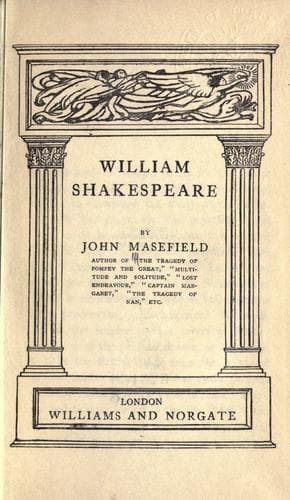
Shakespeare, William, 1564-1616 -- Criticism and interpretation
They are married. The Duke marries Viola. Malvolio is released from
prison. Sir Toby marries Maria, Olivia's waiting-woman. Sir Andrew
is driven out like a plucked pigeon. Malvolio, unappeased by his
release, vows to be revenged for the mock put upon him.
This is the happiest and one of the loveliest of all the Shakespearean
plays. It is the best English comedy. The great mind that mixed a
tragedy of intellect with a tragedy of stupidity, here mixes mirth with
romantic beauty. The play is so mixed with beauty that one can see it
played night after night, week after week, without weariness, even in a
London theatre.
The play presents images of self-deception, or delusional
sentimentality, by means of a romantic fable and a vigorous fable. It
shows us three souls suffering from the kind of sickly vanity that feeds
on day-dreams. Orsino is in an unreal mood of emotion. Love is an
active passion. Orsino is in the clutch of its dangerous passive enemy
called sentimentality. He lolls upon a couch to music when he ought to
be carrying her glove to battle. Olivia is in an unreal mood of mourning
for her brother. Grief is a destroying passion. Olivia makes it a form
of self-indulgence, or one sweet the more to attract flies to her.
Malvolio is in an unreal mood of self-importance. Long posing at the
head of ceremony has given him the faith that ceremony, of which he is
the head, is the whole of life. This faith deludes him into a life of
day-dreams, common enough among inactive clever people, but dangerous to
the indulger, as all things are that distort the mental vision. At the
point at which the play begins the day-dream has brought him to the
pitch of blindness necessary for effective impact on the wall.
The only cure for the sickly in the mind is reality. Something real has
to be felt or experienced. Life that is over-delicate and remote
through something unbalanced in the mind is not life but decay. The
knife, the bludgeon, the practical joke, and the many-weaponed figure of
Sorrow are life's remedies for those who fail to live. We are the
earth's children; we have no business in limbo. Living in limbo is like
living in the smoke from a crater: highly picturesque, but too near
death for safety.
Orsino is cured of sentiment by the sight of Sebastian making love like
a man. He rouses to do the like by Viola. Olivia is piqued out of
sentiment by coming to know some one who despises her. She falls in love
with that person. Malvolio is mocked out of sentiment by the knowledge
that other minds have seen his mind. He has not the happiness to be
rewarded with love at the end of the play; but he has the alternative of
hate, which is as active a passion and as real. All three are roused to
activity by the coming of something real into their lives; and all
three, in coming to the active state, cease to be interesting and
beautiful and pathetic.
Public-domain text, read in full here on John Shaqi.
Reviews
Reviews
No reviews yet
Be the first to share your thoughts on this work.
Join the Discussion
Join the discussion
Sign in to leave a comment or review.
Sign InorCreate an account