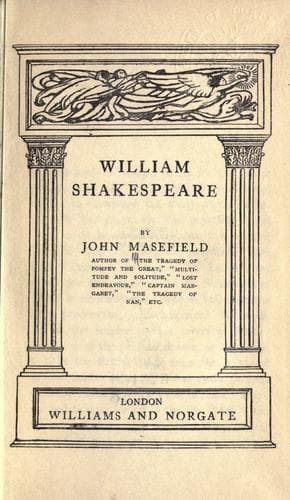
Shakespeare, William, 1564-1616 -- Criticism and interpretation
Shakespeare's tragical characters are all destroyed by the excess of
some trait in them, whether good or ill matters nothing. Nature cares
for type, not for the excessive. Sooner or later she checks the
excessive so that the type may be maintained. She is stronger than the
excessive, though she may be baser. To Nature, progress, though it be
infinitesimal, must be a progress of the whole mass, not a sudden
darting out of one quality or one member.
Timon of Athens is betrayed by an excessive generosity. Coriolanus is
betrayed by an excessive contempt for the multitude. He is one born into
a high tradition of life. He has the courage, the skill in arms, and the
talent for affairs that come with high birth in the manly races. He has
also the faith in tradition that makes an unlettered upper class narrow
and obstructionist. Like the rich in France before the Revolution, he
despises the poor. He denies them the right to complain of their hunger.
Rather than grant them that right, or the means of urging redress, he
would take a short way with them, as was practised here, at Manchester
and elsewhere.
"Would the nobility lay aside their ruth,
And let me use my sword, I'ld make a quarry
With thousands of these quarter'd slaves, as high
As I could pick my lance."
Like all conservative, aristocratic men, he sees in the first granting
of political power to the people the beginning of revolution.
"It will in time
Win power upon and throw forth greater themes
For insurrection's arguing."
He regards the people as a necessary, evil-smelling, many-headed beast,
good enough, under the leadership of men like himself, to make inferior
troops to be spent as the State pleases. It is possible that Napoleon
and Bismarck looked upon the mob with similar scorn. The ideas are those
of an absolute monarch or super-man. The country squire holds those
ideas, though want of power and want of intellect combine to keep him
from applying them. The sincerity of the ideas is tested from time to
time, in free countries, by general elections.
Public-domain text, read in full here on John Shaqi.
Reviews
Reviews
No reviews yet
Be the first to share your thoughts on this work.
Elsewhere in the archive
Join the Discussion
Join the discussion
Sign in to leave a comment or review.
Sign InorCreate an account