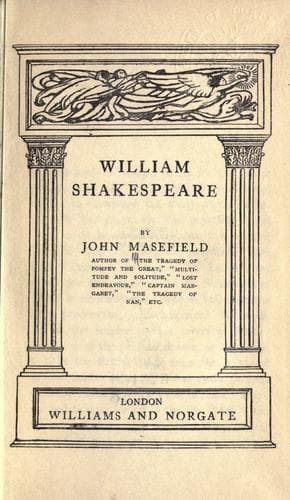
Shakespeare, William, 1564-1616 -- Criticism and interpretation
In this play, as in the two other original romantic plays, Shakespeare
follows the workings of a treacherous act from its performance to the
repentance of the sinner and the granting of the victim's forgiveness.
In the great plays the victim dies and the sinner does not repent.
Presently the wheel comes full circle, and a justice from outside life
smites him dead. In these plays the betrayed live to forgive the
traitors--
"Though with their high wrongs I am struck to the quick,
Yet, with my nobler reason, 'gainst my fury
Do I take part. The rarer action is
In virtue than in vengeance: they being penitent,
The sole drift of my purpose doth extend
Not a frown further."
In this play, as in the other two and in _Pericles_, much is made of the
chances and accidents of life, and of the sudden changes of worldly
circumstance due to them. In this play, for the first and last time,
Shakespeare treats of the power of the resolved imagination to command
the brutish, the base, the noble and the spiritual for wise human ends.
It is easy to interpret the play as allegory. Youth in this country has
reason to regard allegory as a clumsy man's way of introducing Sunday on
a weekday. It is so seldom successful that it may be called the literary
method of creative minds below the first rank. Shakespeare's method was
never allegorical. The _Tempest_ is perhaps no more allegorical than
any other good romance. But the thought of it is so clear that the first
impression given is that it is thin. It is the study of a man of
intellect, who has been forced from power by a treacherous brother.
Living alone with his bright, unspoiled daughter, he attains, by
intellectual labour, to a power over destiny. Like the wise man of the
proverb, he learns to master his stars. He uses this power nobly to put
an end to ancient hatred and old injustice.
The minor vision of the play is a study, often very amusing, but deeply
earnest, of the coming of the fifth part civilised to the mostly brutal.
In Shakespeare's time, men like the quite thoughtless and callous
Stephano and Trinculo, the "sea-dogs" who manned our ships, and of whom
Raleigh wrote that it was an offence to God to minister oaths to the
generality of them, were "spreading civilisation" in various parts of
the world. Shakespeare, looking at them gravely, saw them to be,
perhaps, more dangerous to the needs of life, to wisdom, and to unlit
animal strength than the base Sebastian and the treacherous Antonio.
The exquisite lyrics, and the masque of the goddesses, show that the
taste of the audience of 1610-11 needed to be tickled. Times had changed
since the lion-like and ramping days, eighteen years before, when
"Jeronimy" was a new word, and Tamora a serious invention. The man who
had changed the times was thinking, like Prospero, that he had "got his
dukedom," and that now, having "pardoned the deceiver," he might go to
Stratford to enjoy it.
_King Henry VIII_, or _All is True_.
Public-domain text, read in full here on John Shaqi.
Reviews
Reviews
No reviews yet
Be the first to share your thoughts on this work.
Elsewhere in the archive
Join the Discussion
Join the discussion
Sign in to leave a comment or review.
Sign InorCreate an account