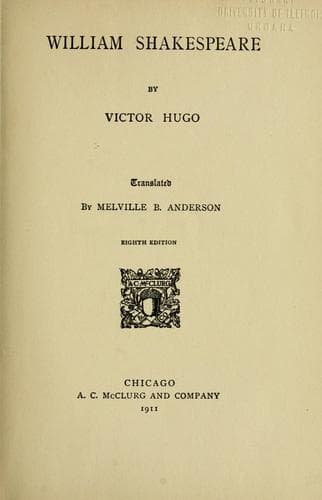
Dramatists, English -- Early modern, 1500-1700 -- Biography; Shakespeare, William, 1564-1616; Stratford-upon-Avon (England) -- Biography
livres, besides the regiment of France, to the Count de Médavid; four
hundred thousand livres to the Bishop of Noyon, because this bishop was
Clermont-Tonnerre, a family that had two patents of count and peer of
France,--one for Clermont and one for Tonnerre; five hundred thousand
livres to the Duke of Vivonne; and seven hundred thousand livres to
the Duke of Quintin-Lorges, besides eight hundred thousand livres to
Monseigneur Clement de Bavière, Prince-Bishop of Liége. Let us add that
he gave a thousand livres pension to Molière. We find in Lagrange's
journal in the month of April, 1663, this remark:--
"About the same time, M. de Molière received, as a great
wit, a pension from the king, and has been placed on the
civil list for the sum of a thousand livres."
Later, when Molière was dead and interred at St. Joseph, "Chapel of
ease to the parish of St. Eustache," the king pushed patronage so far
as to permit his tomb to be "raised a foot out of the ground."
6. Shakespeare, as we see, remained as an outsider a long time on the
threshold of theatrical life. At length he entered. He passed the
door and got behind the scenes. He succeeded in becoming call-boy,
vulgarly, a "barker." About 1586 Shakespeare was barking with Greene at
Blackfriars. In 1587 he gained a step. In the piece called "The Giant
Agrapardo, King of Nubia, worse than his late brother, Angulafer,"
Shakespeare was intrusted with carrying the turban to the giant. Then
from a supernumerary he became actor, thanks to Burbage, to whom, by
an interlineation in his will, he left thirty-six shillings, to buy
a gold ring. He was the friend of Condell and Hemynge,--his comrades
whilst alive, his publishers after his death. He was handsome; he had
a high forehead, a brown beard, a mild countenance, a sweet mouth, a
deep look. He took delight in reading Montaigne, translated by Florio.
He frequented the Apollo tavern, where he would see and keep company
with two _habitués_ of his theatre,--Decker, author of the "Gull's
Hornbook," in which a chapter is specially devoted to "the way a
man of fashion ought to behave at the play," and Dr. Symon Forman,
who has left a manuscript journal, containing reports of the first
representations of the "Merchant of Venice," and "A Winter's Tale." He
used to meet Sir Walter Raleigh at the Siren Club. Somewhere about that
time, Maturin Régnier met Philippe de Béthune at la Pomme de Pin. The
great lords and fine gentlemen of the day were rather prone to lend
their names in order to start new taverns. At Paris the Viscount de
Montauban, who was a Créqui, founded Le Tripot des Onze Mille Diables.
At Madrid, the Duke of Medina Sidonia, the unfortunate admiral of the
"Invincible," founded the Puño-en-rostro, and in London Sir Walter
Raleigh founded the Siren. There you found drunkenness and wit.
Public-domain text, read in full here on John Shaqi.
Reviews
Reviews
No reviews yet
Be the first to share your thoughts on this work.
Join the Discussion
Join the discussion
Sign in to leave a comment or review.
Sign InorCreate an account