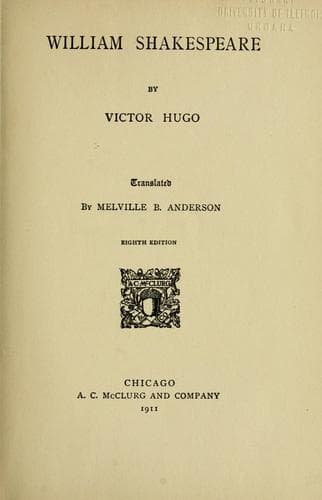
Dramatists, English -- Early modern, 1500-1700 -- Biography; Shakespeare, William, 1564-1616; Stratford-upon-Avon (England) -- Biography
7. In 1589, when James VI. of Scotland, looking to the throne of
England, paid his respects to Elizabeth, who, two years before, on the
8th February, 1587, had beheaded Mary Stuart, mother of this James,
Shakespeare composed his first drama, "Pericles." In 1591, while the
Catholic king was dreaming, after a scheme of the Marquis d'Astorga,
of a second Armada, more lucky than the first, inasmuch as it never
put to sea, he composed "Henry VI." In 1593, when the Jesuits obtained
from the Pope express permission to paint "the pains and torments of
hell," on the walls of "the chamber of meditation" of Clermont College,
where they often shut up a poor youth, who the year after, became
famous under the name of Jean Châtel, he composed "Taming the Shrew."
In 1594, when, looking daggers at each other and ready for battle,
the King of Spain, the Queen of England, and even the King of France,
all three said "my good city of Paris," he continued and completed
"Henry VI." In 1595, while Clement VIII. at Rome was solemnly aiming
a blow at Henry IV. by laying his crosier on the backs of Cardinals
du Perron and d'Ossat, he wrote "Timon of Athens." In 1596, the year
when Elizabeth published an edict against the long points of bucklers,
and when Philip II. drove from his presence a woman who laughed when
blowing her nose, he composed "Macbeth." In 1597, when this same Philip
II. said to the Duke of Alba, "You deserve the axe," not because the
Duke of Alba had put the Low Countries to fire and sword, but because
he had entered into the king's presence without being announced, he
composed "Cymbeline" and "Richard III." In 1598, when the Earl of Essex
ravaged Ireland, bearing on his headdress the glove of the virgin Queen
Elizabeth, he composed the "Two Gentlemen of Verona," "King John,"
"Love's Labour's Lost," "The Comedy of Errors," "All's Well that Ends
Well," "A Midsummer Night's Dream," and "The Merchant of Venice." In
1599, when the Privy Council, at her Majesty's request, deliberated
on the proposal to put Dr. Hayward to the rack for having stolen some
of the ideas of Tacitus, he composed "Romeo and Juliet." In 1600,
while the Emperor Rudolph was waging war against his rebel brother
and sentencing his son, murderer of a woman, to be bled to death, he
composed "As You Like It," "Henry IV.," "Henry V.," and "Much Ado about
Nothing." In 1601, when Bacon published the eulogy on the execution
of the Earl of Essex, just as Leibnitz, eighty years afterward, was
to find out good reasons for the murder of Monaldeschi, with this
difference however, that Monaldeschi was nothing to Leibnitz, and that
Essex had been the benefactor of Bacon, he composed "Twelfth Night;
or, What you Will." In 1602, while in obedience to the Pope, the King
of France, styled "Renard de Béarn" by Cardinal Aldobrandini, was
counting his beads every day, reciting the litanies on Wednesday, and
the rosary of the Virgin Mary on Saturday, while fifteen cardinals,
Public-domain text, read in full here on John Shaqi.
Reviews
Reviews
No reviews yet
Be the first to share your thoughts on this work.
Join the Discussion
Join the discussion
Sign in to leave a comment or review.
Sign InorCreate an account