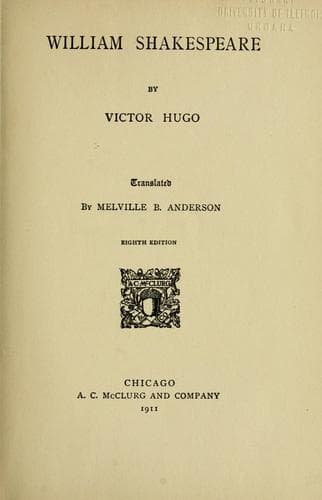
Dramatists, English -- Early modern, 1500-1700 -- Biography; Shakespeare, William, 1564-1616; Stratford-upon-Avon (England) -- Biography
God may be there, but it removes nothing, as we have proved, from
the sourness of critics; the greatest minds are those which are most
brought into question. It even sometimes happens that true intellects
attack genius; the inspired, strangely enough, do not recognize
inspiration. Erasmus, Bayle, Scaliger, St. Evremond, Voltaire, many of
the Fathers of the Church, whole families of philosophers, the whole
School of Alexandria, Cicero, Horace, Lucian, Plutarch, Josephus, Dion
Chrysostom, Dionysius of Halicarnassus, Philostratus, Metrodorus of
Lampsacus, Plato, Pythagoras, have severally criticised Homer. In this
enumeration we omit Zoïlus. Men who deny are not critics. Hatred is
not intelligence. To insult is not to discuss. Zoïlus, Mævius, Cecchi,
Green, Avellaneda, William Lauder, Visé, Fréron,--no cleansing of these
names is possible. These men have wounded the human race through her
men of genius; these wretched hands forever retain the colour of the
mud that they have thrown.
And these men have not even either the sad renown that they seem to
have acquired by right, or the whole quantity of shame that they have
hoped for. One scarcely knows that they have existed. They are half
forgotten,--a greater humiliation than to be wholly forgotten. With
the exception of two or three among them who have become by-words
of contempt, despicable owls, nailed up for an example, all these
wretched names are unknown. An obscure notoriety follows their
equivocal existence. Look at this Clement, who had called himself
the "hypercritic," and whose profession it was to bite and denounce
Diderot; he disappears, and is confounded, although born at Geneva,
with Clement of Dijon, confessor to Mesdames; with David Clement,
author of the "Bibliothèque Curieuse;" with Clement of Baize,
Benedictine of St. Maur; and with Clement d'Ascain, Capuchin, definator
and provincial of Béarn. What avails it him to have declared that the
work of Diderot is but an "obscure verbiage," and to have died mad at
Charenton, to be afterward submerged in four or five unknown Clements?
In vain did Famien Strada rabidly attack Tacitus; one scarcely knows
him now from Fabien Spada, called _L'Epée de Bois_, the jester of
Sigismond Augustus. In vain did Cecchi vilify Dante; we are not
certain whether his name was not Cecco. In vain did Green fasten on
Shakespeare; he is now confounded with Greene. Avellaneda, the "enemy"
of Cervantes, is perhaps Avellanedo. Lauder, the slanderer of Milton,
is perhaps Leuder. The unknown De Visé, who tormented Molière, turns
out to be a certain Donneau; he had surnamed himself De Visé, through a
taste for nobility. Those men relied, in order to create for themselves
a little _éclat_, on the greatness of those whom they outraged. But
no, they have remained obscure. These poor insulters did not get their
salary. Contempt has failed them. Let us pity them.
CHAPTER II.
Public-domain text, read in full here on John Shaqi.
Reviews
Reviews
No reviews yet
Be the first to share your thoughts on this work.
Elsewhere in the archive
Join the Discussion
Join the discussion
Sign in to leave a comment or review.
Sign InorCreate an account